How to Get C-Suite Buy-In for a Pricing Change

.png)
TL;DR
- About a third of our discovery calls surface the same question from CMOs and VP Product Marketers: "How do I sell a pricing change internally?"
- Even strong pricing strategies stall when leadership isn’t aligned on execution.
- C-suite pushback tends to fall into seven predictable concerns–and each one is solvable with the right structure.
- We built a one-page, 9-box framework called the Pricing Strategy Canvas that helps you build a decision-ready business case–organized as WHY → HOW → WHAT.
How Do You Sell a Pricing Change Internally?
By building a structured business case that addresses every executive concern before it's raised – not by pitching a new pricing model.
A VP of Product Marketing at a $23M software company recently asked our team: "Can you help me build a business case for our CEO? I know we need to transform our pricing, but I need help making the pitch." It's a question we hear constantly – roughly a third of our discovery calls at Pricing I/O surface the same ask.
I felt this tension personally. In 2019, I was at Mercatus, a Series B PE-backed software company, and saw a clear opportunity in fixing our pricing. No one owned it, and it showed plainly when a salesperson gave away unlimited users to close a blue-chip deal. I knew what needed to happen, but the fear of pitching the CEO and the career risk of being wrong nearly stopped me.
After reviewing dozens of successful transformations at Pricing I/O, I discovered the pattern: companies that rolled out successful pricing changes didn't have better strategies. They had better methods for communicating the change internally.
That insight – combined with what we hear from CMOs and product marketing leaders every week – led us to build a framework specifically for this problem: the Pricing Strategy Canvas. Before we get to it, let's unpack why the C-suite resists pricing changes in the first place. Because if you don't address their specific concerns, no framework will save you.
Why Does the C-Suite Resist Pricing Changes?
Executives resist because pricing transformations create uncertainty across every function simultaneously – revenue, sales, customers, and operations – and most proposals don't address that uncertainty head-on.
The resistance is rarely about the pricing model itself. It's about what could go wrong during execution. And the stakes have never been higher: In 2026, SaaS pricing isn’t "set and forget" – teams are adjusting pricing and packaging multiple times per year, and AI has introduced real variable costs back into software economics. According to Growth Unhinged's 2025 State of B2B Monetization report – a survey of 240 software and AI companies – seat-based pricing dropped from 21% to 15% adoption in just 12 months, while hybrid models surged from 27% to 41%. The market is moving fast, which means the cost of executive hesitation is compounding every quarter.
Here are the seven concerns I hear most often – some surface in the first meeting, others are structural barriers that only emerge when you start pushing:
The through-line across all seven: executives don't need to be convinced that pricing matters. They need to see a plan that makes the change feel manageable. You do that by building a business case that answers every one of these concerns before they're asked.
How Do You Build a Business Case for a Pricing Change?
The most effective approach uses a single-page business case organized in three layers:
- WHY the change is needed
- HOW you’ll execute
- WHAT it requires
Each section answers one critical question your C-suite will ask–and completing it often reveals gaps and misalignments before you walk into the room.
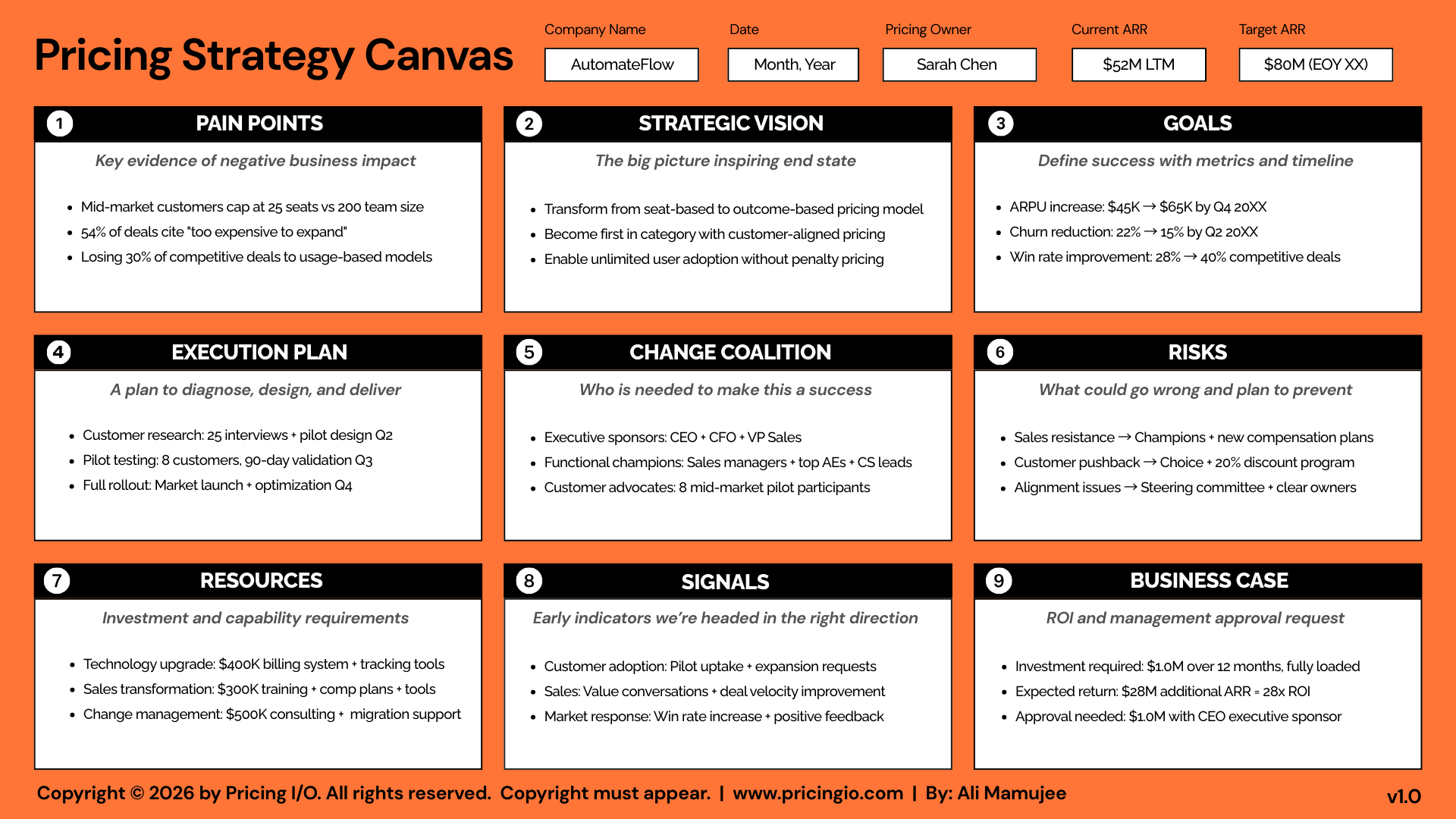
We built a framework for this called the Pricing Strategy Canvas–one page, nine boxes, three layers. It takes about 30 minutes to fill out.
Example: AutomateFlow is a fictional $50M workflow automation company shifting from seat-based to outcome-based pricing. The metrics below are illustrative.
Start with WHY (Boxes 1–3)
The WHY layer establishes the case for change. If you can't fill these three boxes with hard evidence, you're not ready to present.
Box 1: Pain Points – lead with the business problem, not the pricing model. Gather revenue leakage data, win/loss analysis, customer expansion friction, and competitive pricing intelligence. Every point should be measurable, not anecdotal. The stronger the evidence here, the easier every subsequent box becomes.
Box 2: Strategic Vision – define the inspiring end state, framed in terms your CEO and board care about. Connect the pricing change to competitive differentiation and market positioning, not just a revenue number. Pricing is the vehicle, not the destination.
Box 3: Goals – set specific, measurable targets with timelines. Tie every goal to a metric the executive team already tracks: ARPU, churn rate, competitive win rate, expansion revenue. If your goals require new metrics, define how you'll measure them from day one.
Move to HOW (Boxes 4–6)
The HOW layer turns vision into an approved plan.
Box 4: Execution Plan – lay out a phased timeline, not a big-bang launch. Apply new pricing to new business first, then renewals, then existing contracts. Each phase should generate data that validates the next step. No executive wants to bet the entire revenue model on a single switch-flip.
Box 5: Change Coalition – map the stakeholders who need to be involved. This is the box most people skip and most transformations fail without. Identify executive sponsors, functional champions in sales and customer success, and customer advocates for the pilot. Before presenting to the full team, have 1-on-1 conversations with every person who has influence or veto power. By the time you present, the outcome should be largely pre-decided.
Box 6: Risks – name them explicitly with specific mitigations and owners. Every concern from the resistance table above should have a corresponding line here. Vague risk statements ("there might be pushback") are worse than no risk section at all.
End with WHAT (Boxes 7–9)
The WHAT layer makes it real.
Box 7: Resources – specify what the money buys, not just the total. Break the investment into categories: technology, sales enablement, change management. Executives approve line items, not round numbers. If you need external help, say so – trying to do a fundamental model shift with stretched internal resources is a common failure mode.
Box 8: Signals – define early indicators within 60–90 days that prove you're on track. Pipeline velocity, new deal ASP, customer upgrade rates, sales cycle length. Leading indicators matter more than lagging ones – total ARR impact takes quarters to materialize. These are the proof points you'll bring back to unlock the next phase.
Box 9: Business Case – the financial narrative and the specific ask. Quantify both sides: the return from acting and the cost of waiting. Use your own data – expansion friction, win-rate declines, flat NRR – to build a projection specific to your business.
Three rules for presenting your case. Have 1-on-1 conversations with stakeholders first – the group presentation should be for alignment, not persuasion. Start with Box 1 – executives need to feel the pain before they'll engage with the vision. End with a specific ask – "We need $X approved with [name] as sponsor to begin Phase 1 in [month]."
What Happens When You Don’t Get C-Suite Alignment?
Without C-suite alignment, even strong pricing strategy stall into politics, half-hearted execution, and quiet sabotage.
In practice, that shows up as:
- Sales pushing back on comp and quota impact
- Finance blocking on forecast risk
- CS worrying about churn and exceptions
- No clear owner to run the rollout
The Pricing Strategy Canvas is built to prevent that. It puts the concerns, plan, and ask in one place - so leadership can approve Phase 1 without guessing.
Ready to build your business case?
Download the free Pricing Strategy Canvas v1.0 and start aligning your leadership team around a pricing transformation that grows ARR, simplifies your model, and defends your valuation.
Want hands-on help? Pricing I/O has helped 400+ B2B SaaS companies design and launch pricing that works. We're hands-on strategists who build with your team – not a firm that drops a slide deck and disappears. Talk to Pricing I/O
Frequently Asked Questions (FAQs)
1) What should I bring to the first exec conversation about pricing?
Bring three things: a clear problem statement (what’s breaking), 2–3 data points (expansion friction, win/loss, discounting, churn), and the specific decision you want (pilot approval, budget, sponsor). Don’t lead with a new model–lead with evidence and a phased plan.
2) Who should own the pricing change internally?
One executive sponsor must own the decision (usually CEO or CFO), and one operator must run the workstream (often PMM, Product, or RevOps). If “ownership” is shared across teams, it becomes no one’s job–and the rollout stalls.
3) What’s the minimum pilot that still creates confidence?
A 60–90 day pilot with a small, controlled scope: new business only (or a single segment), a defined pricing package, and 3–5 early success signals (e.g., win-rate, ASP, cycle time, expansion intent). The goal isn’t perfection–it’s proof.
4) Should we apply the new pricing to existing customers or only new deals?
Most teams start with new business first, then move to renewals, then migrate existing customers. This reduces churn risk, creates internal confidence, and gives Finance clean before/after data.
5) How do I handle sales compensation concerns without starting a war?
Don’t surprise Sales. Bring them in early with options: temporary SPIFFs, quota relief during transition, a pilot team, and a clear “how we’ll measure it” plan. The fastest path is co-designing the transition, not announcing it.
6) What’s the biggest mistake people make when pitching pricing to execs?
Asking for a full rollout decision too early. Execs say no when the decision feels irreversible. Ask for Phase 1 approval–research + pilot–with clear signals that unlock the next phase.
7) What should the ‘ask’ actually be at the end of the presentation?
A specific approval with three parts: budget, sponsor, and start date. Example: “Approve $X for Phase 1, with [Name] as exec sponsor, starting in [Month].”
8) What is a pricing business case?
A pricing business case is a one-page argument–backed by evidence, projections, and an execution plan–that makes a pricing change decision-ready. It addresses stakeholder risk upfront and ends with a clear ask and measurable success criteria.

Ready to grow with confident pricing?
Let's start a conversation with our team that will deliver practical value even if you don't work with us.