TL;DR
- Penetration pricing sets an entry price below perceived value to win adoption fast, then earns from upgrades, expansion or a later increase. In B2B SaaS it's usually one entry point inside a larger pricing model.
- It pays off only if the product gets stickier with use, a paid option sits above the entry price, and the entry plan holds back enough that bigger customers don't buy it instead.
- It backfires when customers anchor on the low price, competitors match it, the cheap plan eats the plan above it, or it attracts customers who were never a fit.
- Pricing I/O's 5Q Pricing Framework™ tests the decision: why, who, what, how much, and which numbers show it's working.
- Moving off it means changing the package with the price, and grandfathering with an end date rather than forever.
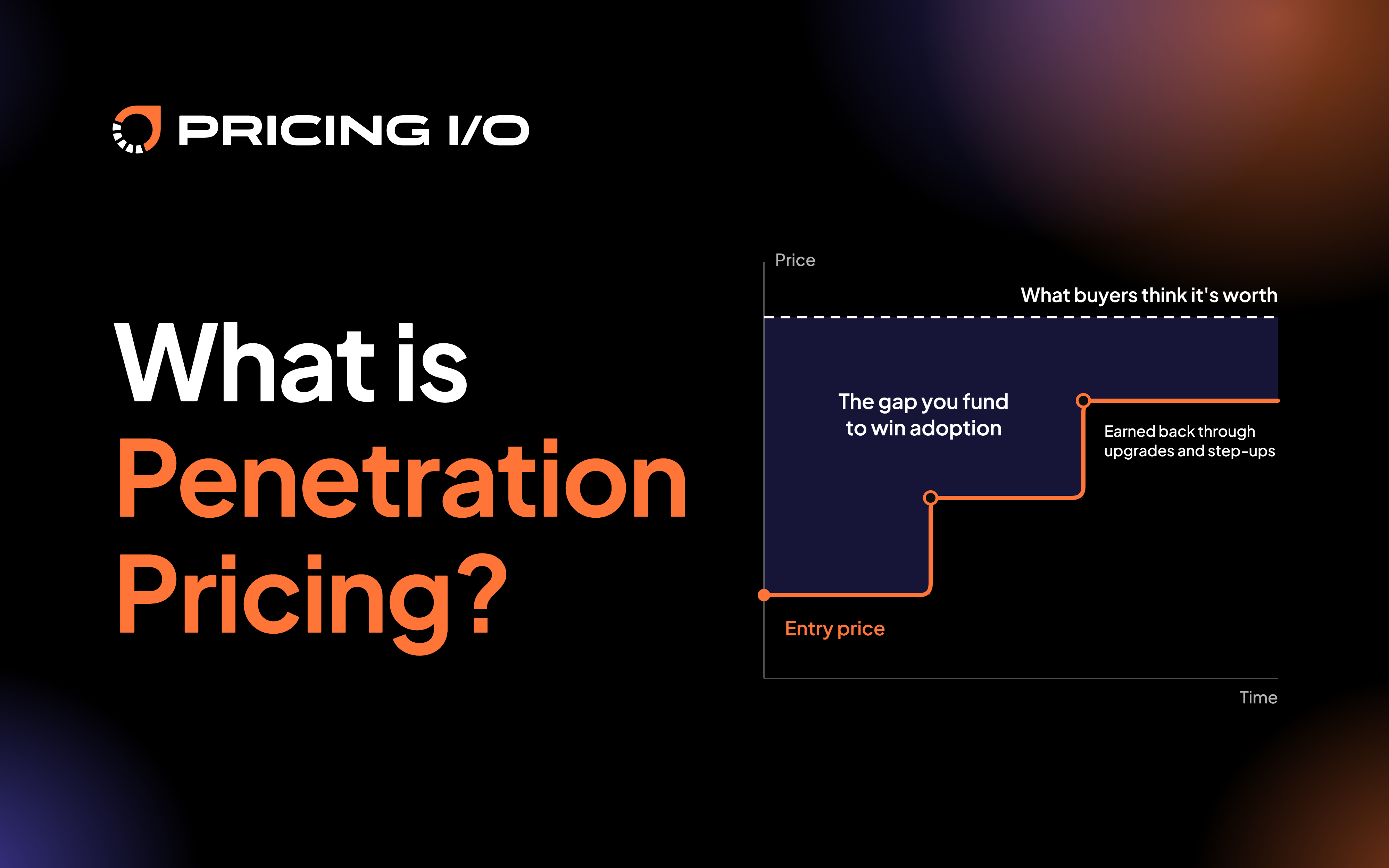
Penetration pricing means setting a price below what buyers believe a product is worth so they adopt it quickly, then earning the difference back through upgrades, expansion or a later price increase. It pays off when customers get more attached the longer they use the product, a paid option sits above the entry price, and the business can fund the gap until customers move up. When one of those is missing, the low price tends to become the permanent price.
In B2B SaaS, penetration pricing is rarely a whole company launched cheap. It's usually one low entry point inside a larger pricing model: a free tier, a starter plan or a small first contract.
What is penetration pricing?
Penetration pricing is a pricing strategy that sets the price of a product, plan or contract below its perceived value – what a buyer thinks it's worth compared with the alternatives – to lower the barrier to trying it and win market share quickly. The gap is an investment the company plans to recover later.
In B2B SaaS it usually means an established company adding a low entry point to reach a price-sensitive segment or drive adoption of a new add-on. Freemium is the extreme case: the entry price is $0 and the limits on the free plan do all the work of moving people to paid.
It isn't a discount. A discount is a concession on one deal, while a penetration price is the published price for an entry point, with a plan for when it changes.
Penetration pricing is one of three ways to set a launch price:
How does penetration pricing work?
Penetration pricing works as a sequence. A low entry price gets the product adopted, regular use makes it harder to leave, and a paid option above the entry price turns that attachment into revenue. If customers don't stay, or nothing sits above the entry price, the company is left with cheap customers and no way to charge them more.
The low price also costs money while it lasts, because support, onboarding and infrastructure grow with every entry customer, paying or not. Before launch, 4 numbers are worth modelling:
- The cost to serve 1 entry customer
- The share of entry customers who move up to a paid plan
- How long it takes them to move up
- What they pay once they do
A made-up example shows why. Say a free plan costs $10 per user per month to run.
- 100 people sign up for free. That's $1,000 a month going out.
- After 6 months, 5 of them upgrade to a $200 plan. That's $1,000 a month coming in.
- The other 95 stay free, and they still cost $950 a month.
So the company earns $50 a month on the whole group, after 6 months of earning nothing. The 95 who never pay are the problem. Either more of them have to upgrade, the 5 who pay have to grow, or the 95 have to stop costing money. That last one is why free and starter plans carry limits on storage, seats or history.
When does penetration pricing backfire?
The common failures:
- Customers who have been paying the entry price treat it as the real price, so a later increase reads as a price hike.
- Competitors match the cut, and margins fall across the category.
- Customers who would have paid for the plan above take the cheap one instead. This cost is easy to leave out of the model, and it can outweigh everything the entry price wins.
- The low price draws in customers who were never a fit, and they churn.
- A product priced well below its peers looks cheap, which makes larger customers harder to win later.
Four of the five come from launching the low price without deciding, in advance, what it excludes and when it ends. The exception is competitors matching the cut, which is outside the company's control.
The fit problem catches teams out because the early numbers look good. Miguel Dergal, head of growth at Canva when he joined the Street Pricing podcast, described how an earlier team of his at Invoice2go cut its starter price, reworked the free plan, and saw conversion jump from single digits to the mid-double digits. The customers who came in at that price then retained worse and filed more complaint tickets than earlier cohorts, so the team moved the starter price back up to a midpoint and repackaged so the gap between Starter and Pro was wider.
A low entry price also speaks to fewer buyers than it seems. In Pricing I/O and Benchmarkit's 2026 survey of 296 software buyers, only 19% ranked lowest entry price among their top three criteria when evaluating AI software; 68% ranked predictable total cost.
How do you decide if penetration pricing fits your product?
Penetration pricing fits when five things are true: leadership has agreed when the low price has to pay back, the buyers it attracts will stay and grow, the entry plan holds back what larger customers need, the step-up is planned with the entry price, and you can track whether entry customers move up. If any one of them fails, the low price stops being temporary.
Those five checks follow Pricing I/O's 5Q Pricing Framework™, which works through 5 questions in order: why you are creating this pricing, who you want to win, what the offer mix is, how much to charge, and which parts are working. As Marcos Rivera, Pricing I/O's founder and CEO, put it on the Product Mastery Now podcast, how much to charge "is one of the last things to figure out." Penetration pricing is an answer to that fourth question, so it only holds if the first three support it and the fifth keeps checking it.
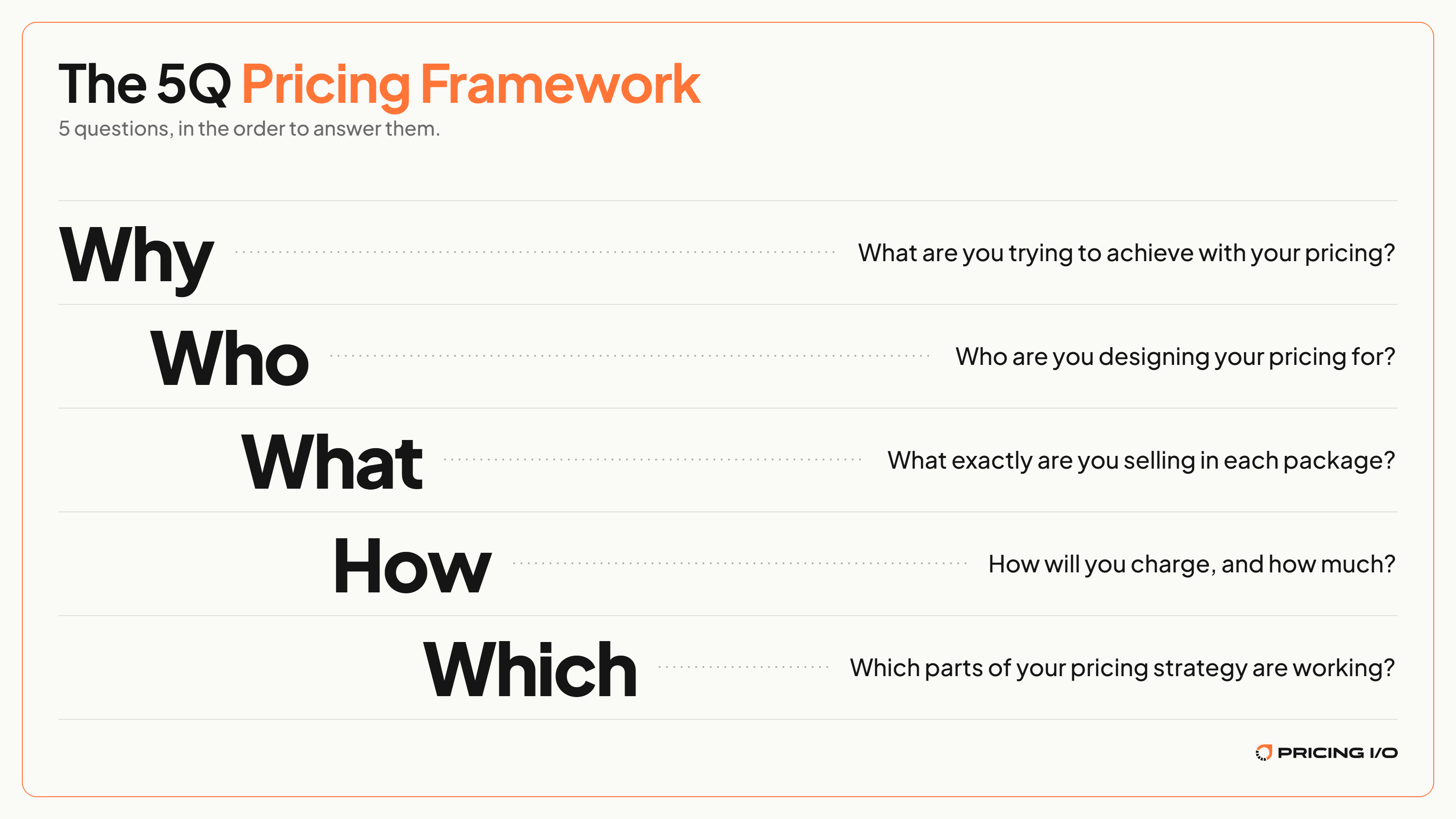
1. Why: What are you trying to achieve with your pricing?
Penetration pricing fits when the goal is adoption or market share now and revenue later, and leadership has agreed how long "later" can be. If the board expects margin this year, a low entry price works against the plan. The point where it has to start paying back – a date, a customer count or a contract term – belongs in the plan before launch.
2. Who: Who are you designing your pricing for?
A low price attracts the most price-sensitive buyers in a market, so the question is whether those buyers are worth keeping: do they stay, do they grow into the next plan, and what do they cost to serve. Invoice2go's cheaper cohort failed the first test, and the price went back up.
3. What: What exactly are you selling in each package?
This decides what the entry price buys. Put too much in and customers never need to upgrade. Put too little in and they never see enough value to want to. The entry plan also has to hold back the one thing larger customers can't do without, or it takes sales from the plan above it. A limit on seats, usage or a capability is friction at the right point, and it's what moves customers to the next tier.
4. How: How will you charge, and how much?
For a penetration price, both parts matter. A model that grows with the customer, such as per user or usage-based, lets revenue rise without a list-price increase. For AI products, where each customer's usage carries a real cost, a low base price with usage-based add-ons keeps the entry price low without giving away the expensive part, and spend caps or alerts keep the bill predictable for the buyer. And the entry price and the step-up get set together, with the step-up written into the plan or contract terms from day one. A low first contract for a fixed term, renegotiated on actual usage, gives the customer a clear point where the price changes. A flat low list price has no such point, so raising it later means a general price increase, which is harder to land.
5. Which: Which parts of your pricing strategy are working?
Entry customers need their own scorecard: the share who upgrade, how long it takes, how the entry cohort retains against other cohorts, and what each one costs to serve. Marcos Rivera's warning sign, from a Street Pricing episode with Bill Wilson: if 40%, 50% or 60% of customers sit in the entry plan without moving up, either the entry plan is too generous or the jump to the next plan is too big.
How do you move off penetration pricing without losing the customers it won?
The move works when the price and the package change together. Customers compare any new number against the price they've been paying, so a higher number on the same plan reads as a price hike. A new plan name, new limits or something added gives them a different thing to judge and ties the increase to value they can see. Invoice2go did both at once.
Grandfathering existing customers on the old price buys goodwill, but grandfathering everyone forever is one of the 5 things to avoid when pricing SaaS, because the old price never stops being the real price. A grandfather period with an end date, or a migration in cohorts, works better, with proper notice (Pricing I/O's guidance on telling customers about a price increase puts it at 30 days minimum, 60 to 90 for larger clients). Some loss is likely anyway, because customers who signed only for the price are the first to leave. That churn is easier to defend if it was budgeted for when the entry price was set.
Frequently asked questions
Is freemium a form of penetration pricing?
Yes. It's the extreme case, with an entry price of $0 and all revenue coming from conversion and expansion.
Does penetration pricing work for enterprise software?
A low list price usually doesn't, because it signals lower quality. A low first contract for a fixed term, renegotiated on actual usage, can work.
What is the 5Q Pricing Framework?
Pricing I/O's question-based method for building pricing: why you're creating this pricing, who you want to win, what the offer mix is, how much to charge, and which parts are working.
If you're weighing a low entry price, or trying to move off one set years ago, Pricing I/O's strategists can work through the 5 questions with your own customer data. Book a call.