TL;DR
In 2026, SaaS pricing is no longer 'set and forget.' Companies are adjusting pricing and packaging multiple times per year, and AI introduced real variable costs back into software economics. This guide breaks down 10 B2B SaaS pricing models – including AI SaaS pricing, usage-based, hybrid, credits, and outcome-based approaches – with decision rules for when each model works and when it breaks. You’ll also learn core pricing strategy frameworks, psychological tactics that actually matter in B2B, the key metrics to track for each model, and a decision tree to choose the right pricing model based on what drives customer value (users, usage, or outcomes).
The goal: help you choose and design pricing that buyers can forecast and defend internally while protecting your margins.
What is a SaaS Pricing Model?
A SaaS pricing model is the structure that determines how customers pay for your software. It defines the value meter – whether you charge for seats, usage, features, or outcomes.
A pricing model is different from a pricing strategy. Your pricing strategy is how you decide what customers should pay (value-based, competitive, cost-plus). Your pricing model is how that strategy shows up in the product – the mechanism customers actually buy through.
In practice, modern teams design pricing and packaging together. Your packaging strategy, feature gating, and plan tiers determine how value is perceived just as much as the price itself.
Why are SaaS Pricing Models Changing in 2026?
AI Changed the Cost Equation
Traditional SaaS was close to zero marginal cost per user. AI isn’t. Every AI interaction can incur compute cost – especially when you’re paying per token or per model call. OpenAI and Anthropic publish explicit per-token pricing, which is exactly what many SaaS builders are now absorbing inside their COGS.
Enterprise AI spend is also rising quickly. Zylo’s 2026 SaaS Management Index found AI-native application spend up 108% YoY, and 393% YoY in large enterprises. This is why AI SaaS pricing increasingly shifts toward "access vs consumption" packaging – so teams can recover inference costs while still delivering predictable, forecastable spend.
Implication: "Unlimited AI" inside a flat subscription can silently destroy margins.
Pricing Velocity Accelerated
Pricing used to be revisited every few years. Now it's continuous. The typical SaaS company is adjusting pricing and packaging multiple times per year – tuning tiers, entitlements, limits, and add-ons on an ongoing basis. Pricing is now an operating cadence rather than an annual exercise.
Implication: Your pricing needs to be a system with knobs (tiers, limits, levers) – not a one-time page redesign.
Software Inflation Stayed High
Vertice measured SaaS YoY price increases averaging ~13.5% in Q4 2025 (with monthly readings in the 12–15% range).
Implication: buyers are scrutinizing renewals harder, asking for predictability, and pushing back on surprise overages.
Simple Pricing Started Breaking Margins
In 2024–2025, many companies bundled AI into existing plans to move fast. A lot of them later reintroduced limits, credits, or base+usage so margins didn’t collapse. That "access vs consumption" split shows up repeatedly in modern packaging changes.
In 2026, the default "winning" pattern is to separate access (subscription) from consumption (usage/credits/outcomes), so you can stay predictable for buyers and safe on margins
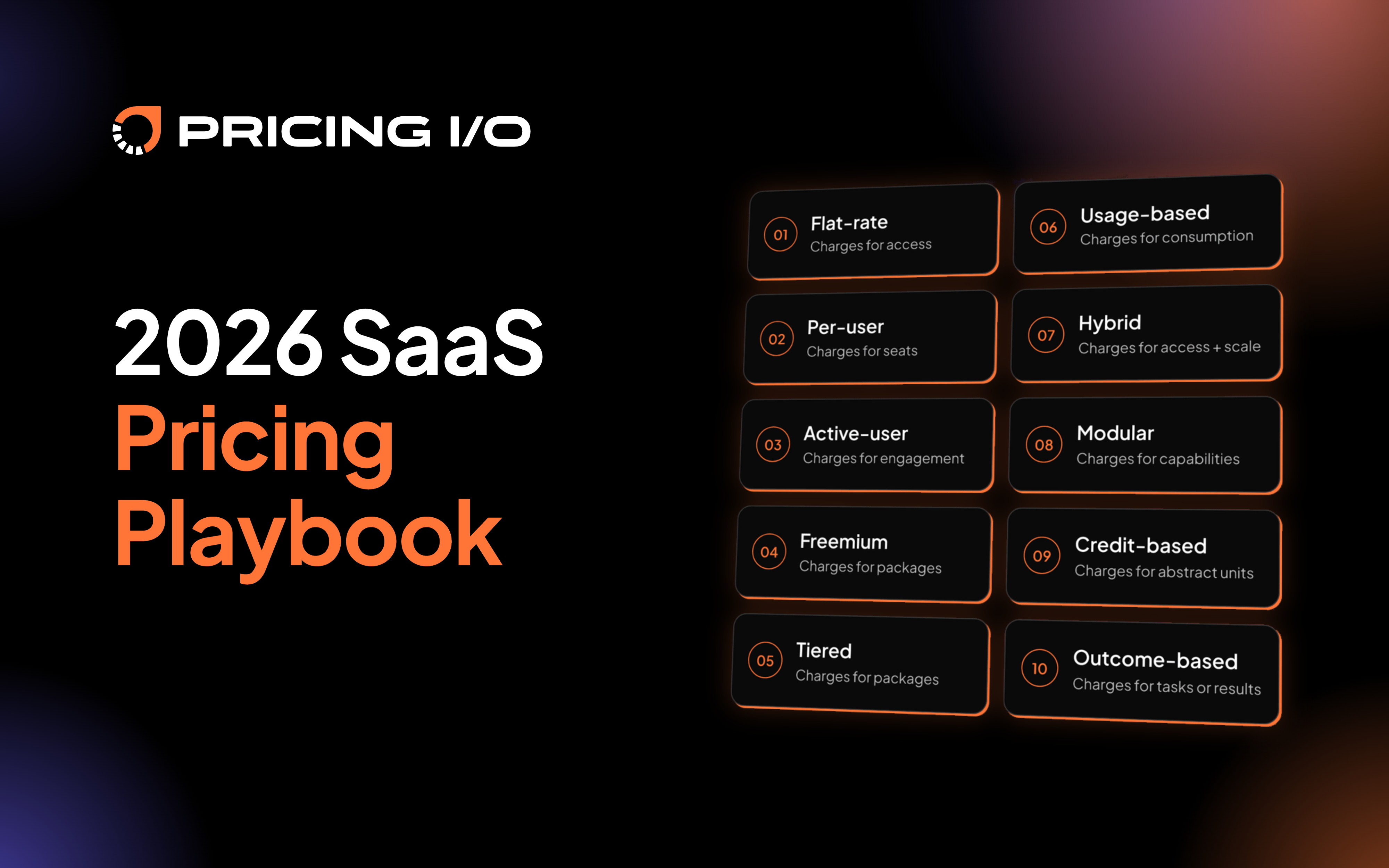
What are the Main SaaS Pricing Models?
How each pricing model works and where it breaks
What is Flat-Rate Pricing?
Flat-rate pricing charges every customer the same fee regardless of usage, users, or features consumed. One price, unlimited access.
When it works: Flat-rate pricing works best for products with straightforward value propositions serving a relatively uniform customer base. It eliminates decision friction and accelerates sales cycles because there's nothing to configure or calculate.
Companies like Basecamp have built their entire go-to-market around simplicity, charging $299/month for unlimited users and projects.
When it breaks: Flat-rate pricing breaks when you serve diverse customer segments with vastly different usage patterns or willingness to pay. A solo consultant and a 500-person enterprise shouldn't pay the same price, yet flat-rate models force this misalignment. It also caps your revenue from high-value customers and provides no natural expansion path.
Best metrics to track:
- Customer acquisition cost (CAC)
- Churn rate
- Average revenue per account (ARPA)
What is Per-User (Seat-Based) Pricing?
Per-user pricing charges based on the number of individual users accessing the software, typically measured in "seats" or named users.
When it works: Per-user pricing works well when your product's value scales linearly with the number of people using it – collaboration tools, CRMs, and project management platforms fit this pattern. Zoom, Atlassian Jira, and countless others use this model because adding users directly correlates with expanding the product's value footprint within an organization.
When it breaks in 2026: The rise of AI agents is creating fundamental challenges for per-user pricing. When software automates work previously done by humans, charging per "user" becomes problematic – if an AI agent replaces 10 analysts, should you charge for one seat or ten? Additionally, seat-sharing practices and the desire to enable broad organizational access without per-seat penalties are pushing companies to reconsider this model.
Best metrics to track:
- Seats per account
- Seat expansion rate
- Revenue per seat
- Active vs inactive seat utilization
What is Tiered Pricing?
Tiered pricing offers multiple packages at different price points, typically differentiated by features, usage limits, or support levels (Good/Better/Best structure).
When it works: Tiered pricing works when you have clearly differentiated customer segments with distinct needs and budgets. It provides an upgrade path for customer growth and allows you to capture different willingness to pay across your market. HubSpot exemplifies this with distinct tiers for solopreneurs, small businesses, and enterprises.
When it breaks: Tiered pricing breaks when tier design is poor – either too many tiers creating decision paralysis, or tier boundaries that don't align with natural customer segments. It also fails when feature gating frustrates users or when the pricing structure becomes so complex that sales cycles slow down.
Best metrics to track:
- Tier distribution
- Upgrade and downgrade rates
- Feature adoption by tier
What is Freemium Pricing?
Freemium pricing offers a permanently free tier with limited functionality, monetizing through conversions to paid plans.
When it works: Freemium works when your product has viral or network effects that make free users valuable for acquisition, when marginal costs to serve free users are low, and when there's a clear trigger that drives upgrades. Slack, Zoom, Notion, Figma, and Calendly all built massive businesses on freemium – free users become internal champions who drive paid adoption.
When it breaks: Freemium breaks when free users consume significant resources without converting, when your product delivers full value without paid features, or when there's no natural upgrade trigger. If your free tier is "too good," you subsidize users who never pay. If it's too limited, users churn before experiencing value.
Best metrics to track:
- Free-to-paid conversion rate
- Time to conversion
- Viral coefficient (invites per user)
- Cost to serve free users
What is Usage-Based Pricing?
Usage-based pricing (also called consumption-based pricing) charges customers based on their actual consumption of the product – API calls, data processed, transactions completed, or other measurable units of value. You’ll also hear this described as "pay-as-you-go SaaS pricing," especially in developer and infrastructure products.
When it works: Usage-based pricing excels when usage correlates strongly with value delivered and when consumption varies significantly across customers. Infrastructure providers (AWS, Snowflake, Datadog) demonstrate this model's power – customers pay only for resources consumed, reducing adoption friction while capturing expansion as usage grows.
When it breaks: When it breaks: Usage-based pricing breaks when consumption is unpredictable, making it difficult for customers to forecast costs, which is one reason AI software buyers increasingly prefer pricing they can predict and control. It also struggles when your product doesn't have easily measurable usage metrics that correlate with value. The model can hurt revenue predictability and complicate financial planning for both vendors and customers often showing up as bill shock during renewals or expansion.
Real example: Zapier prices based on "tasks" (automated actions), allowing customers to scale from 750 tasks/month on entry plans to unlimited on enterprise tiers. This aligns pricing directly with automation value delivered while providing clear tiers for different business sizes.
Best metrics to track:
- Consumption per account
- Revenue per unit consumed
- Marginal cost per unit
- Expansion revenue from usage growth
What is Active User Pricing?
Active user pricing charges based on users who actually engage with the product during a billing period, rather than total licensed seats. For many AI products, this "base + consumption" approach has become the default hybrid pricing model in 2026: predictable access plus variable spend tied to compute-heavy usage.
When it works: Active user pricing works when usage patterns are sporadic or seasonal, and when you want to encourage broad deployment without penalizing customers for inactive accounts. Slack pioneered this approach, charging only for users who logged in during the billing period, which reduced adoption friction for enterprise-wide rollouts.
When it breaks: Active user pricing creates revenue unpredictability, making it difficult to forecast and plan. It can also complicate billing operations and customer communications around what constitutes "active." Additionally, customers may not use the product even with access, reducing engagement.
Best metrics to track:
- Active user rate
- Revenue per active user
- Activation and engagement rates
What is Outcome-Based Pricing?
Outcome-based pricing charges customers based on results achieved rather than access, usage, or features – for example, per resolved support ticket, per qualified lead generated, or per successful transaction.
When it works: Outcome-based pricing works when outcomes are clearly measurable, directly attributable to your product, achieved quickly after use, valued similarly across customers, and verifiable automatically without human judgment.
Salesforce's Agentforce charges $2 per customer conversation handled by AI agents. Zendesk charges $1.50 per successfully resolved customer interaction. These models work because the outcome is clear, measurable, and the product owns the workflow end-to-end.
When it breaks: Outcome-based pricing breaks when attribution becomes murky – if multiple factors contribute to an outcome, customers will dispute charges. It struggles with long feedback loops between action and outcome, when outcomes vary in value across customers, and when success metrics that work at 10 customers don't scale to 1,000.
Best metrics to track:
- Outcomes delivered per customer
- Customer satisfaction with attribution
- Contract negotiation time
What is Hybrid Pricing?
Hybrid pricing combines a base subscription fee with usage-based charges, attempting to balance revenue predictability with value alignment.
When it works: Hybrid models work when you need revenue stability from base subscriptions while capturing expansion from variable usage. They're particularly effective for platforms where core functionality justifies a fixed fee but consumption creates additional value.
When it breaks: Hybrid pricing breaks when it becomes too complex, creating confusion for customers trying to forecast costs. It also fails when the base fee is set incorrectly relative to typical usage patterns, leading to most revenue coming from either fixed or variable components rather than both.
Real example: HubSpot combines tiered base plans with usage-linked components such as contact tiers and volume-based limits.
Best metrics to track:
- Revenue mix (base vs variable)
- Net revenue retention
- Usage overage frequency
What is Modular Pricing?
Modular pricing unbundles features or products into separate SKUs that customers can add to a core subscription.
When it works: Modular pricing works when customer needs vary significantly and when add-on modules serve distinct use cases or departments. It allows customers to pay only for capabilities they need while providing clear upsell paths. Enterprise software often uses this approach – SAP recently transitioned from bundled RISE packages to modular Cloud ERP Private Edition with separate SKUs for AI, analytics, and other capabilities.
When it breaks: Modular pricing breaks when it creates excessive complexity, forcing customers to assemble their own solution from dozens of options. It can also fail when module pricing doesn't reflect the relative value of components, leading to pricing inconsistency.
Best metrics to track:
- Module attach rate
- Revenue per module
- Cross-sell effectiveness
What is Credit-Based Pricing?
Credit-based pricing gives customers a bank of units (credits/tokens) that are consumed when they use specific capabilities – most commonly AI features. In developer-facing products, the most common implementation is token-based pricing, where customers pay per input/output token processed, with model-specific rates. Credit systems often serve as a bridge between raw LLM token pricing and buyer-friendly packaging, helping normalize variable AI workloads into predictable allowances.
When it works: This model works best when unit costs are tightly tied to consumption (e.g., inference calls/GPU time) and usage varies widely across customers. It’s especially useful as a transitional monetization layer when AI value metrics are still emerging, because it normalizes variable workloads into predictable allowances or pay-as-you-go spend. OpenAI and Anthropic price API usage by tokens with model-dependent rates, and Miro allocates AI credits based on plan tiers.
When it breaks: Credit systems fail when customers can’t translate credits into intuitive value. Opaque mappings, surprise overages, and limited spend controls undermine trust – especially as AI shifts from differentiated add-on to expected baseline functionality. Many vendors respond by bundling core AI into paid tiers and adjusting base prices (e.g., Slack included core AI in paid tiers and raised Business+ from $12.50 to $15).
Additionally, as credit-based models proliferate across SaaS products, buyers are experiencing "credit fatigue" – managing multiple credit systems across vendors creates procurement friction. As more companies adopt credit models, customers increasingly push for simpler, more transparent pricing structures. Credits work best as a temporary bridge, not a permanent model, unless your entire product is consumption-driven (like API platforms).
Best metrics to track:
- Credit / token consumption rate
- Credit utilization (% of purchased credits used)
- Margin per AI action or per 1K tokens
How to Choose the Right SaaS Pricing Model?
Pricing Model Decision Tree
Start: What drives customer value most?
1) Value scales with number of users
- If users are fairly equal in value → Per-user (seat-based)
- If you’re worried about shelfware / inactive seats → Active-user
- If some users are power users and others are light users → Tiered per-user (seat tiers, role-based tiers)
2) Value scales with consumption / usage
- If usage is predictable and controllable → Usage-based
- If usage varies and buyers need predictability → Hybrid (base + usage)
- If different features have different unit costs → Credit-based (credits map to actions)
3) Value scales with business outcomes
- If you control the end-to-end workflow → Outcome-based
- If attribution is messy → Work-based proxy (usage metric tied to work performed)
- If customers want predictability → Hybrid with success incentives (base + outcome kicker)
4) Value is consistent regardless of users/usage
- → Flat-rate or Tiered by feature set
5) Multiple value drivers
- → Hybrid (base subscription + one or more variable components)
What are the Core Pricing Strategy Frameworks for SaaS?
A pricing strategy defines how you decide what customers should pay.
What is Value-Based Pricing?
Value-based pricing sets prices according to the perceived value customers receive, not your costs or competitors' prices. It requires a deep understanding of how different customer segments quantify the business outcomes your product delivers.
The framework involves:
- Identifying the economic value you create (cost savings, revenue generation, efficiency gains)
- Quantifying that value in dollar terms for different customer segments
- Setting prices that capture a fair portion of the value created
- Differentiating pricing based on value received, not just features provided
According to HBR, value-based pricing requires answering:
- What is the next best alternative (NBA) to your product?
- How does your product compare to that alternative?
- What is the customer's perception of your product's differentiated value?
The primary challenge is execution. Value-based pricing is research-intensive and requires ongoing customer discovery, win/loss analysis, and willingness-to-pay validation.
What is Competitive Pricing?
Competitive pricing sets your prices relative to competitors – matching, undercutting, or pricing above based on differentiation.
This approach carries significant risk. You're adopting someone else's pricing context without understanding their cost structure, customer mix, or strategic objectives.
As a result, competitive pricing works best as a validation mechanism – ensuring prices fall within a reasonable market range – rather than as a primary pricing strategy.
What is Cost-Plus Pricing?
Cost-plus pricing adds a fixed margin on top of your costs to serve customers.
The formula is straightforward:
Price = Cost of Goods Sold (COGS) + Desired Margin
While simple to calculate, cost-plus pricing ignores customer value perception and competitive dynamics. In SaaS, where marginal costs are low and value delivery can be high, cost-plus typically results in significant underpricing.
Cost-plus pricing is most useful as a constraint – you should never price below sustainable unit economics – rather than as a standalone strategy.
What is Penetration Pricing?
Penetration pricing deliberately sets low initial prices to acquire customers quickly and build market share, with plans to increase prices over time or monetize through expansion revenue.
Freemium is the most aggressive form of penetration pricing – where the entry price is $0 and monetization happens entirely through conversion and expansion.
This approach makes sense when:
- Network effects make early user volume valuable
- Your land-and-expand motion depends on getting in the door cheaply
- Switching costs will make customers sticky once onboarded
- You're well-funded and prioritizing growth over near-term profitability
The primary risk is anchoring customer value perception at a low price point. Penetration pricing often attracts price-sensitive customers who churn when prices rise. That’s why penetration pricing should be treated as a temporary entry tactic, not a long-term pricing strategy, and must be paired with a clear expansion or repricing path.
How Pricing Strategy Works in Practice (B2B SaaS)
In practice, strong SaaS pricing strategies combine these approaches:
- Value-based pricing sets the anchor
- Competitive pricing provides market validation
- Cost awareness establishes guardrails
- Penetration pricing supports market entry when speed matters
Pricing models then translate this strategy into execution through seats, usage, tiers, credits, or outcomes. Strong pricing systems also require operational discipline: clear pricing governance, defined ownership, and ongoing review of discounting, entitlements, and expansion paths. Without this, even well-designed pricing models slowly degrade.
Do Psychological Pricing Tactics Work in B2B SaaS?
Psychological pricing works in B2B SaaS but differently than B2C. Effectiveness depends on your sales motion and buyer sophistication.
What is Charm Pricing?
Charm pricing uses prices ending in 9 to trigger the "left-digit effect" – buyers perceive $99 as significantly cheaper than $100, even though the difference is just 1%.
Works for: Self-serve/PLG motions, SMB customers, entry-level tiers.
Doesn't work for: Enterprise deals, premium positioning, or products where round numbers signal quality.
How Does Price Anchoring Work?
Price anchoring places a higher-priced option first so other options seem more affordable. Buyers evaluate prices relatively, not absolutely.
Example: When buyers see a $500/month enterprise tier first, the $200/month pro tier feels reasonable. Show them the $200 tier first, and it feels expensive. Same price, different perception.
How to apply it: Lead with premium tiers on pricing pages. Show annual pricing ($2,388/year) before monthly ($249/month). In sales calls, present the full-featured option first.
What is Decoy Pricing?
Decoy pricing adds a less attractive option to make your target tier look like better value.
Example:
- Basic at $49/month (10 features)
- Pro at $199/month (15 features)
- Pro Plus at $249/month (25 features)
The jump from Basic to Pro costs $150 for 5 features ($30/feature). The jump from Pro to Pro Plus costs $50 for 10 features ($5/feature). Pro Plus becomes the obvious choice – that 6x better value-per-feature is the mechanism.
How Does Good-Better-Best Pricing Work?
Three-tier structures leverage "extremeness aversion" – buyers avoid the cheapest and most expensive options.
Example structure:
- Good at $29/month captures price-sensitive buyers
- Best at $299/month anchors value and captures enterprise
- Better at $99/month is your target – where most of the customers typically land
Design "Better" to be your most profitable tier.
How Should You Frame SaaS Prices?
How you present prices matters as much as the prices themselves. $297/month can be framed 4 different ways:
- Daily: "$9.90/day" - reduces sticker shock on expensive products
- Annual: "$3,564/year" - emphasizes commitment, works for discounts
- Per-user: "$29.70/user for a 10-person team" - ties cost to value
- ROI: "Costs $297/month, saves $3,000/month" - 10x return framing
Choose the frame that makes value easiest to grasp for your specific buyer.
What are Some Practical SaaS Pricing Lessons?
From working with hundreds of SaaS teams, Marcos Rivera (CEO of Pricing I/O) highlights a few patterns that show up again and again:
- Start with customer interviews, not the pricing page
- Your sales team knows more than your spreadsheets
- Simplify before you optimize
- Test willingness-to-pay before launching pricing
- Discounting over ~20% usually means packaging is broken
- If customers game your tiers, you’re charging for the wrong thing
- If everyone is on your cheapest plan – red flag
- If nobody upgrades – also a red flag
- An "Enterprise" tier alone isn’t a strategy
- Pricing isn’t a project. It’s a muscle
SaaS Pricing Models FAQ (2026)
1) What is the best SaaS pricing model in 2026?
There isn’t one best model. The best model is the one where (1) your value meter matches how buyers perceive value, (2) your costs scale predictably, and (3) customers can forecast and defend spending internally.
2) How do you price AI features in SaaS without killing margins?
Avoid "unlimited AI" in a flat plan unless you have strict fair-use controls. Most teams use a base tier that includes a reasonable AI allowance, then add usage, credits, or outcome fees for heavier workflows. The rule: bundle baseline AI, monetize heavy AI.
3) How do you prevent bill shock in usage-based pricing?
Give buyers forecasting tools: hard limits, alerts, spend caps, commit discounts, and clear overage rules. The simplest pattern is tiers + included usage + predictable overages. If customers can’t estimate next month’s bill in under 60 seconds, your usage model will create renewal friction.
4) When does seat-based pricing break in 2026?
Seat-based breaks when seats stop being the value driver – for example when AI agents do the work, or when companies want broad access without being penalized per user. If customers are asking to "roll it out to everyone" but arguing about seats, consider active-user, usage, or hybrid.
5) Are credits a good model, or do buyers hate them?
Credits work when they’re transparent and mappable. Buyers hate credits when they feel like "arcade tokens." If you use credits, you must: map credits to actions/outcomes, show real-time burn, and give spend controls. Otherwise procurement will push back hard.
6) Are hybrid models better for AI products?
Often, yes. Hybrid is a practical compromise: predictable access + variable consumption. It aligns with AI economics (variable inference costs) while still giving customers budgetability.
7) How often should SaaS companies change pricing?
Pricing shouldn’t change constantly, but it should be reviewed on a cadence. A common pattern is: quarterly packaging review, semiannual price review, annual major changes. Most "pricing churn" is actually packaging and entitlements tuning – not list price changes.
8) What’s the difference between pricing and packaging?
Pricing is what customers pay. Packaging is what they get. In SaaS, packaging usually drives outcomes: tiers, feature gating, limits, add-ons, and entitlements shape buying behavior more than small price changes.
9) What metrics tell you your pricing model is working?
Look for: NRR, expansion mix (seat vs usage), discount rate stability, gross margin by segment, and "forecastability" (how often customers hit surprise overages). If margin improves but NRR drops, your value meter may be wrong.
10) What’s the biggest pricing mistake in 2026?
Shipping a pricing model you can’t operate. If you don’t have usage instrumentation, billing accuracy, governance, and sales enablement, hybrid/usage/credits will create disputes. The best pricing model is the one your org can run cleanly.
Conclusion
In 2026, SaaS pricing isn’t something you set once and forget. It’s a system you tune as customer behavior, AI costs, and buying dynamics change.
The models that win most often combine clear packaging (tiers) with controlled variability (usage, credits, or outcomes) – so buyers can forecast spend and teams can protect margins.
The right choice always comes back to three questions:
- What does the customer believe they’re paying for?
- What does your cost actually scale with?
- Can buyers forecast and defend spending internally?
If you're unsure where your pricing stands, start with a benchmark. Pricing I/O offers a free Pricing Excellence Scorecard that benchmarks your pricing maturity across packaging, value metrics, usage data, discounting, enablement, and change rollout and gives you a prioritized roadmap for improvement based on your stage and operating reality.