TL;DR
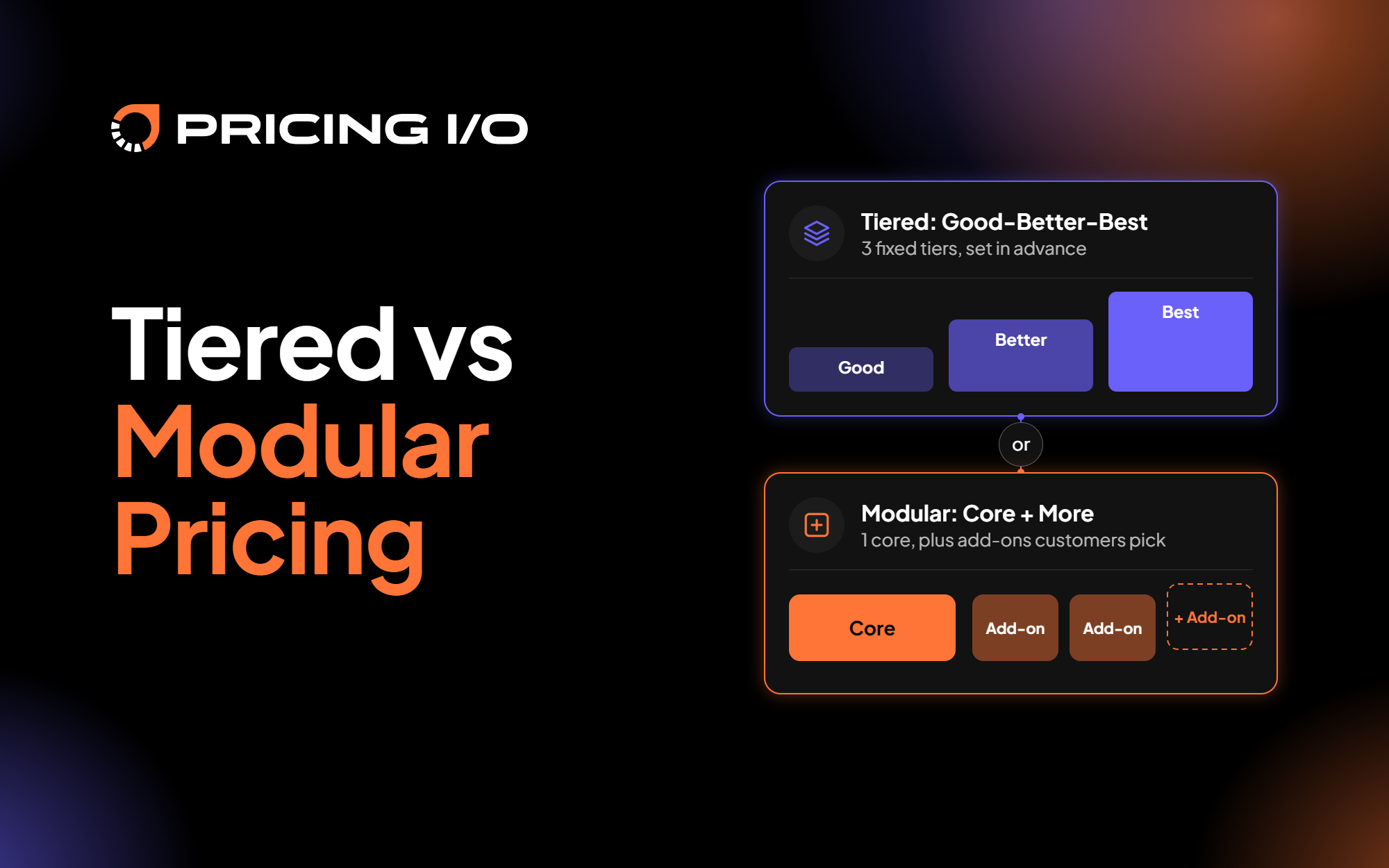
- Good-Better-Best is 3 fixed tiers. Core + More is a base package with add-on modules the customer picks. Both work; they fit different stages.
- Test 1, sales maturity: a new sales team can’t build modular deals on the fly. If most of your reps are new, that’s a red flag for modularity.
- Test 2, growth path: if customers level up in a similar sequence, tiers meet them at each stage. If they grow in different directions, modules fit better.
- Test 3, add-on weight: a module has to be something a customer would pay extra for by itself. Half-products don’t clear that bar.
- Rule of thumb: meaty and mature, go Core + More. They grow like the rest, stick with Good-Better-Best.
- Tiers with a few add-ons sold alongside them is a middle path, and HubSpot runs it. Going fully modular is a separate step.
- The choice isn’t permanent. You can start simple and move to modular as the team and the modules mature.
Every SaaS operator eventually runs into the same packaging question: how modular should our pricing be? You start with one plan, maybe two. Then the product grows, and so do your customers, and you’re deciding whether to keep a few clear tiers or start slicing things into add-ons, bolt-ons and micro-features.
Three things decide it: how mature your sales team is, whether your customers grow along a similar path, and whether your add-ons carry enough value to sell on their own. If the add-ons are meaty and the team is mature, go modular with Core + More: a core package plus add-ons customers pick. If your customers grow like the rest, stick with Good-Better-Best tiers. Below is how I ran those 3 tests with a client that had to pick one, what we chose, what the choice costs, and when the answer flips.
What’s the difference between Good-Better-Best and Core + More?
Good-Better-Best packages the product into 3 tiers at rising prices, and the customer picks the one that matches their stage. Core + More sells a base package that everyone buys, plus separately priced add-ons the customer stacks on as their needs change. One’s more structured, the other’s more flexible.
Both are packaging decisions: what goes in which box. How you charge for each box, per seat, per usage or a flat fee, is a separate call, and either structure can sit on any of them.
The two models are cousins. Rafi Mohammed’s 2018 Harvard Business Review article on Good-Better-Best pricing argues that companies lose profit in two directions, discounting to win price-sensitive buyers and giving high-end customers no reason to spend more, and that a three-tier offering addresses both. Modular packaging makes a different bet: that customers differ enough to pay for exactly what they need and nothing else. In practice the two often sit together. HubSpot sells Marketing Hub in Starter, Professional and Enterprise editions, and sells extra marketing contacts and add-ons such as a dedicated IP alongside them. The 2026 guide to SaaS pricing models covers where tiered and modular pricing each break.
I had to choose between them with a company in the learning and certification space, somewhere in the $10M to $30M ARR range. They were moving off a single-package model, and the internal debate was alive and well. The sales team wanted Good-Better-Best: 3 tiers, easy to pitch, easier to close. The product team wanted a modular approach, what I call Core + More, to reflect all the value they were building and capture more revenue over time. When sales and product pull in different directions on pricing, somebody has to break the tie. They turned to me and said, “Marcos, break the tie.” So we did what I always recommend: zoom out and look at your maturity, your motion and your market. In practice that came down to 3 tests.
1. Is your sales team mature enough for modular pricing?
Modular packaging assumes reps can build solutions on the fly. If your reps are still learning the ropes, a modular model turns into chaos quickly: Frankenstein deals and confused customers. A new sales team is a red flag for modularity.
In this case the team was fresh. Two-thirds of the reps were brand new, and that alone pushed hard toward tiers. A tier is a decision the company has already made for the rep. A module list is a decision the rep makes in the room, and a new rep doesn’t yet know which combinations hold up.
2. Do your customers grow along the same path?
If most customers level up in a predictable sequence, Good-Better-Best meets them at each stage of that path, and the tier boundaries become the upgrade moments. If customers grow in very different ways, by use case, industry or behavior, fixed tiers force dissimilar buyers into the same box, and that’s where modularity shines.
The question to ask of your own base is whether the thing that makes a customer bigger is the same thing across accounts. If growth mostly means more seats or more volume inside the same use case, tiers hold. If one customer’s growth is a compliance workflow and another’s is an analytics layer, those are modules, and a tier that bundles both makes one of them pay for something they’ll never open. The difference between expansion inside a plan and expansion by moving up a tier is the same question seen from the revenue side, and segmentation is how you find out which pattern you have before you package for it.
This client’s customers grew in a predictable way. That was the second point for tiers.
3. Are your add-ons worth paying for on their own?
A module has to be meaty enough to stand on its own. If a customer wouldn’t pay extra for it by itself, it’s a feature, and features belong inside a tier.
We looked at the actual modular pieces this company planned to offer. They didn’t pack enough standalone value. They felt like half-products, the kind of thing customers would appreciate but not pay separately for yet. That was the third point for tiers.
A useful check: could you sell the module to an existing customer in a standalone conversation, with its own price and its own reason to buy? If the honest pitch is “it makes the core a bit better,” it goes in the core. Pricing I/O’s framework for packaging AI features makes the same call: AI that only makes the core a bit faster or smarter goes into the base plan (“underscore the core”), while AI that extends a use case or opens a new one (“upgrade the more”, “unlock the new”) can sit in a premium tier or sell as an add-on.
Why we chose Good-Better-Best, and what it costs
We went with Good-Better-Best. It fit the maturity of the sales team, the predictability of customer growth and the readiness of the product.
The choice has costs, and they run in both directions. Staying simple too long leaves revenue on the table once the modules have grown into something customers would pay for separately. Tiers carry a risk of their own as well: Mohammed’s HBR article stresses fence attributes, the features that keep existing customers from trading down to a cheaper tier. Without them, the Good tier pulls customers who would have paid for more, so 3 tiers only work if the gaps between them are real.
Jumping into complexity too soon costs you too, in Frankenstein deals and confused customers. For this company, with a new sales team and modules that weren’t ready, that was the bigger risk.
When should you move from Good-Better-Best to Core + More?
Move when the 3 tests start pointing the other way: the sales team has grown in capability, the modules have gained enough weight that a customer would buy one on its own, and customers have started growing in different directions. Until the team and the modules are ready, a fully modular model adds choices to the deal without adding revenue. Selling one or two add-ons alongside the tiers is a smaller step, and HubSpot’s Marketing Hub shows the two can sit together.
We didn’t rule out Core + More for this client. Once the team grows in capability and the modules themselves gain weight, it becomes the natural next step. You don’t have to lock yourself into one model forever, and in my experience many companies move from simple to modular as they scale.
The rule of thumb I gave them:
- Meaty and mature? Go Core + More.
- They grow like the rest? Stick with Good-Better-Best.
Start with what fits your team and your customers today, and re-evaluate as you grow: when the sales team has matured, when a module starts getting real pull from customers, or when customers begin growing in directions the tiers don’t cover.
Frequently asked questions
Can you run Good-Better-Best and add-ons at the same time?
Yes. HubSpot sells Marketing Hub in three paid editions and sells extra marketing contacts and add-ons alongside them. The add-on test still applies to each add-on: it has to be something a customer would pay for on its own, or it belongs inside a tier.
How many tiers should Good-Better-Best have?
Three is the structure Rafi Mohammed’s HBR article describes: an entry tier to attract new customers, the existing product in the middle, and a premium tier for customers who want more. The number matters less than whether a distinct group of customers would pick each tier. A tier with no segment behind it is a discount with a name.
What goes wrong when the modules aren’t ready?
Customers won’t pay extra for a half-product. If the add-on is a small improvement to what the core already does, it gets declined, and the rep has one more thing to defend on every call.
How do I know if my sales team is mature enough for Core + More?
Look at how many reps are new and how consistently the team builds deals today. In this case two-thirds of the reps were new, which ruled modularity out. If deals already vary from rep to rep, a module list gives them more ways to build Frankenstein deals.
Does this change for AI features?
The same add-on test applies. AI that makes an existing use case a bit better goes in the base plan. AI that extends a use case or opens a new one can sit in a premium tier or sell as an add-on.
Pricing I/O works with B2B SaaS and AI companies on packaging decisions like this one: tiers, modules and the move between them. Book a call if yours is coming up.