TL;DR:
Asking customers what they'd pay is the fastest way to collect bad pricing data. They have no incentive to reveal a real number, and they don't know your costs or constraints well enough to price your product for you. A good pricing interview does two jobs instead: it establishes what value means to that customer, and it finds the friction blocking that value. Below are the questions that get honest answers, what to do when someone volunteers a number anyway, and why buyers and users need separate scripts.
Pricing is part of the product. Some people go further and say pricing is the product of the product. Either way, the two have to stay in sync if you want to monetize what you build – especially now, with AI changing what buyers expect from pricing. Almost everyone agrees on the next step: talk to your customers.
Far fewer people cover how – how to run the conversation, and which answers to trust. The wrong conversation is expensive: you walk away with data you misread, and you burn time your customer didn't have to give. In the worst case, you introduce risk into your own customer base.
Why shouldn't you ask customers what they'd pay?
Customers give unreliable answers about price for two reasons: they have no incentive to tell you their real number, and they don't have the information to calculate one. Setting the price is your job.
A sales enablement platform brought me in after a pricing change fell flat. They had done what most teams do – formed a hypothesis internally, talked to their customers, pulled a price out of those conversations, and put it on the market. Traction came in weaker than they hoped, and they wanted to know what went wrong. We see a lot of teams at this stage, trying to iterate on pricing the right way instead of churning and burning, and the pattern in their scripts was easy to spot. We pulled the interview guides, listened to the call recordings, and found that every question was aimed at the fee: "What would you pay for this?" "How much money would this be worth to you?" "What's the max price you'd pay?"
I wrote about this in Street Pricing: if you want your customers to tell you the truth, ask about value. If you want them to tell you a lie, ask about price.
Customers don't lie on purpose. They have nothing to gain from revealing the most they'd spend – you're asking them to negotiate against themselves. And even a customer who wanted to hand you a real number couldn't. They know their problem, their use case, and what they want the product to do. They don't know your product limitations, your CPQ, how you manage entitlements, or what your LLM costs look like. Asking them to set your price or design your packages hands them a job they can't do.
Researchers have measured how far off these answers run. Economists John List and Craig Gallet pooled results from 29 experiments comparing what people said they'd pay against what they actually paid; stated values came in around three times higher than real ones, and that's in academic settings with nothing strategic at stake. The survey world's answer was to build indirect methods like Van Westendorp and conjoint analysis that route around the direct question. In a vendor call, the customer also has a reason to shade the number. Either way, the figure can't hold the weight teams put on it.
There's also the cost of the conversation itself. Getting a customer on the phone is hard – they're busy running their own business, which is probably why they bought your product in the first place. Those 15 or 30 minutes are coveted time, and feedback is a gift. Spend it on questions that produce something you can use.
What should a pricing interview uncover instead?
Two things: what value means to this specific customer, and the friction standing between them and that value. My rule going into any customer interview is that you're looking for the friction to remove, not the fee to charge.
Value is the honest starting point because it's territory the customer actually knows. They can speak accurately about the problem, when it shows up, and what they want the product to do about it – which is exactly the raw material value-based pricing is built on.
Friction is what you collect along the way: the limits, gaps, and blockers that stop a customer from getting value or getting more of it. Write down every one. Those notes become pricing and packaging decisions later, and they give you real input the next time you iterate on your pricing model.
Each friction point you write down turns into a decision later: remove it, or keep it and price around it deliberately. Both are fine outcomes. The failure mode is not knowing the friction exists at all.
For the sales enablement platform, this was the fix. We rewrote their script around value and friction, ran 10 solid qualitative interviews, and the pricing work got back on track.
What questions should you ask in a pricing interview?
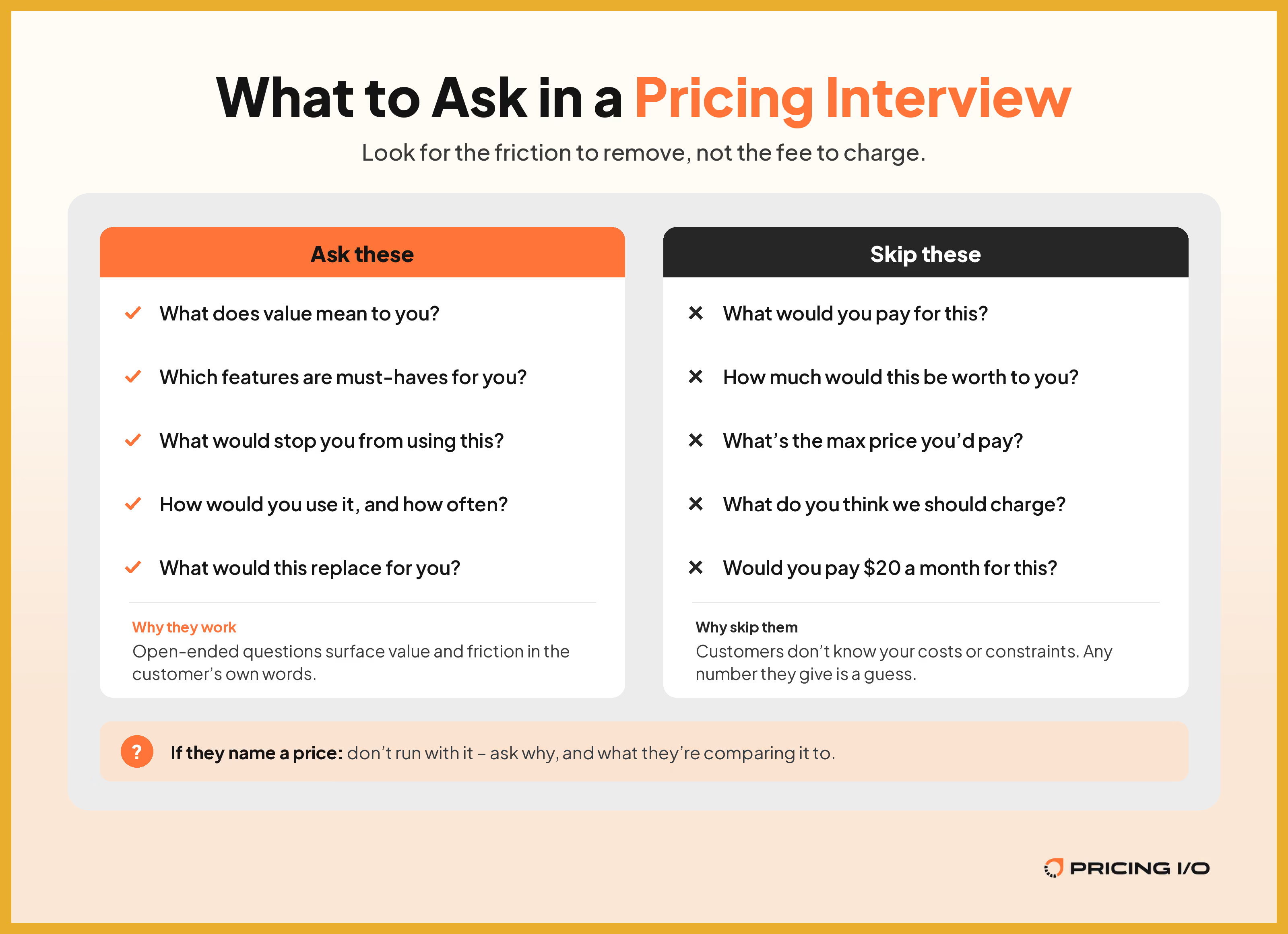
Open-ended questions, starting with "what does value mean to you?" Questions that end in a yes or a no close off the reasoning you came to hear.
"What does value mean to you?" is a legit question to ask straight out. It sounds broad, and that's the point – it gets the customer talking about outcomes in their own words before you steer anything.
If you're showing packages, features, or plan options, a few follow-ups do most of the work:
- Which of these must be included for you to buy?
- What would stop you from using this product?
- How would you use it, and how often?
- What would you stop using if you adopted this?
For an earlier-stage product, ask what the trigger would be for using something like this at all.
Just as important is what stays out of the script: the direct price questions from the story above. If any of them are in your current guide, start the rewrite there.
The friction tends to reveal itself in the answers. "I don't want any limits on my uploads." "A limit on the number of channels is a problem for me, because…" Customers rarely name friction in the abstract, but they'll tell you exactly why a specific limit or pricing metric would keep them from getting value. That's the material you're there to collect.
What should you do when a customer names a price?
Don't take the number and run with it. Push behind it.
A customer will sometimes volunteer a figure mid-interview: "this is worth about $20 a month to me." That's useful, and it's still a starting point. Dig in: why that number? How are they making the comparison? Once you understand where it came from, ask what would have to change in the product for them to pay more – that question is where expansion levers start to surface.
In practice the exchange is short. A customer says the product feels like $20 a month. You ask why $20, and it turns out that's roughly what they pay for the tool they'd be replacing. That one follow-up told you where the anchor comes from – a substitute product – and the anchor is worth more to your pricing work than the $20 itself.
Should you interview buyers and users differently?
Yes. A buyer and a day-to-day user have different goals and see different parts of the product, so one script can't serve both.
Before you schedule anything, check the respondent list: if it mixes pure users with people who also own the purchase decision, those are two different interviews. Buyer-focused interviews should center on value, the alternatives they weighed, and what the problem costs them. User interviews go the other direction: how quickly they can get value, the friction that keeps them from using more of the product, and which capabilities are non-negotiable versus the ones they can live without. It's the same logic that makes segmentation matter inside the pricing model itself.
In script form, the buyer side carries questions like "What does this problem cost you today?" and "What did you consider before this?", while the user side carries "How quickly did you get your first result?" and "Which capability could you not work without?"
There's a lot of rhetoric out there about talking to your customers, and the rhetoric is correct. Learning how to talk to them is the part that usually gets skipped. Go into the call looking for friction to remove and value to understand, and the pricing decisions that follow get much easier to make.
Frequently Asked Questions
Why do customers give unreliable answers about price?
They don't lie on purpose. They have no incentive to reveal the most they'd spend, and they can't see your costs, product limitations, or packaging constraints, so any number they offer is a guess.
What counts as friction in a pricing interview?
Anything that blocks a customer from getting value or getting more of it – upload limits, missing must-have features, barriers to adoption. Note each one so it can be removed or priced deliberately.
Are open-ended or closed questions better?
Open-ended. Closed questions end in a yes or a no and cut off the reasoning behind the answer.
What questions should you avoid in a pricing interview?
Direct price questions – "What would you pay for this?", "What's the max price you'd pay?", "How much would this be worth in dollars?" They ask for a number the customer has no way to calculate.
How many pricing interviews do you need?
There's no universal number. In the project above, 10 solid qualitative interviews were enough to reset the script and the direction of the pricing work.