

TL;DR
- The public AI pricing reversals came from charging for something buyers couldn't connect to value, rather than from charging too much.
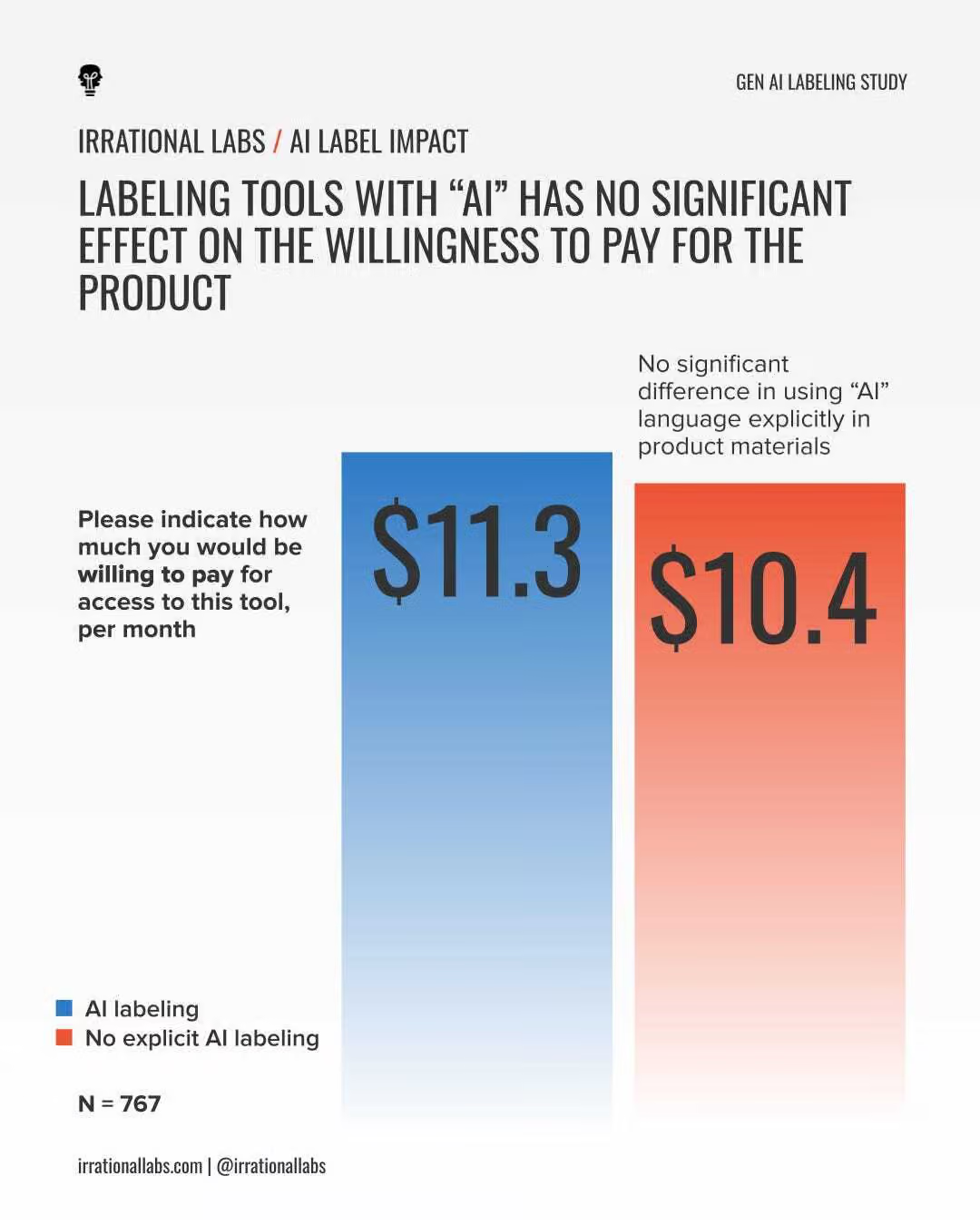
- Adding "AI" to a product description doesn't move willingness to pay. Irrational Labs tested 767 software users and found no significant change in what they'd pay or how far they trusted the output.
- Time savings is what buyers already expect. R.E.A.L. (revenue, expense, avoidance, minus lift) gets you from hours saved to the business result worth pricing against.
- Package by how far the AI sits from what customers already do: underscore the core, upgrade the more, unlock the new.
- Charge for a unit of work customers can count, with a state at the end of it. 63% of software buyers rank a clear value metric in their top three pricing priorities.
AI is in almost every B2B software product now, and charging for it is a separate problem nobody has settled. Some companies fold it into existing plans and absorb the cost, others sell it as a premium add-on or bolt credits on top. Several of the largest software companies in the market have shipped an AI pricing change, watched their customers push back, and reversed it within months. These are companies with real resources and real customer knowledge, and they are still getting this wrong.
Why do AI pricing changes backfire?
Because the new model asks the customer to accept a unit they can't connect to value, on top of everything else they're already absorbing.
Jasper had been around a long time and knew its customers, and it decided seats no longer made sense. It went to consumption and charged by word count. Enough of the customer base pushed back that by May 2023 it had reversed to unlimited words on paid plans. Cursor grew faster than almost anyone in the AI era, changed its usage-based pricing policy, upset its base, and published an apology in July 2025. Salesforce moved Agentforce to per-conversation pricing and met the objection that consumption billing is hard to budget for.
Seats really have stopped tracking value in a lot of products, so the direction wasn't the problem. What these companies underestimated was how much change a customer will absorb at once. Your buyer is already rewriting workflows and working out which agents can be trusted with real work, and replacing the pricing model they've budgeted against for three years lands on top of all of that. That is where the growth damage starts. The pushback arrives, some customers leave, and the work goes into undoing a pricing change rather than building on it.
Line those failures up alongside the ones we see in client work and they stop looking random. The problems fall into three buckets: the value gets framed too low, the packaging gets too complicated, and the company ends up charging for the wrong thing. Here is what each one looks like, and the framework we use to fix it.
Mistake 1: framing the value of AI too low
Most companies price AI against the smallest benefit it delivers, usually because that benefit is the easiest one to prove.
The product label is the first thing teams reach for, and it carries less weight than you'd expect. In January 2025, Irrational Labs ran a controlled experiment with 767 software users, showing them landing pages for four real products with and without the AI framing. Willingness to pay didn't move by any amount the researchers could call significant, trust didn't move either, and describing a product as "generative AI" lowered what people expected it to accomplish.
Time savings is the second thing teams reach for, and it feels safer because you can measure it. It's still too small a claim. Nobody buys software to spend more time on a task, so saved hours are something buyers already expect. Harvard Business Review's research on B2B value points the same way, ranking time savings well behind product quality and vendor expertise as a driver of customer loyalty. What you can charge for is what those hours make possible.
R.E.A.L. is the framework we use to get past the hours. It covers the four places the value of an AI feature shows up:
Revenue is the business result on the other side of the saved time. Take a sales enablement platform that saves reps six hours a month they used to spend moving information between systems. Six hours is the headline, but what matters is what the reps did with them: they talked to more prospects and closed more deals, and that is what the pricing conversation should be about.
Expense is the same work done faster, cheaper, or less often. Fewer tools in the stack, fewer people on a process. Most teams find this one without much prompting.
Avoidance is what the customer no longer has to spend or risk. A penalty they don't incur, a headcount they don't hire, a process they'd otherwise have had to build. It rarely makes it into a pitch, because nothing visibly happens.
Lift is what it costs the customer to reach the value, and it's subtracted rather than added: the speed, friction and effort involved in getting there. The faster a customer reaches value, the more of that value you can capture, which means shortening onboarding creates room to move on price. Most companies never claim it.
Work through all four and you have a number you can put in front of a CFO, which is what value-based pricing needs. Anchor on hours saved instead and you cap what you can charge on every deal that follows.
Mistake 2: packaging AI features the wrong way
The second problem shows up on the pricing page. Some companies include the AI, some don't, some make it an add-on, some drop credits in on top. It confuses customers, and it confuses the sales reps who have to explain it.
The indecision has a cost. In Chargebee's 2025 survey of 473 finance, product and go-to-market leaders, among companies actually selling AI products, 29% were including it in existing packages at no extra charge and 11% were still working out how to charge. Four in ten hadn't started monetizing what they'd built, while inference costs came off the margin daily.
What sorts this out is one question: how far does the AI experience sit from what your customers already do? That distance gives you three routes.
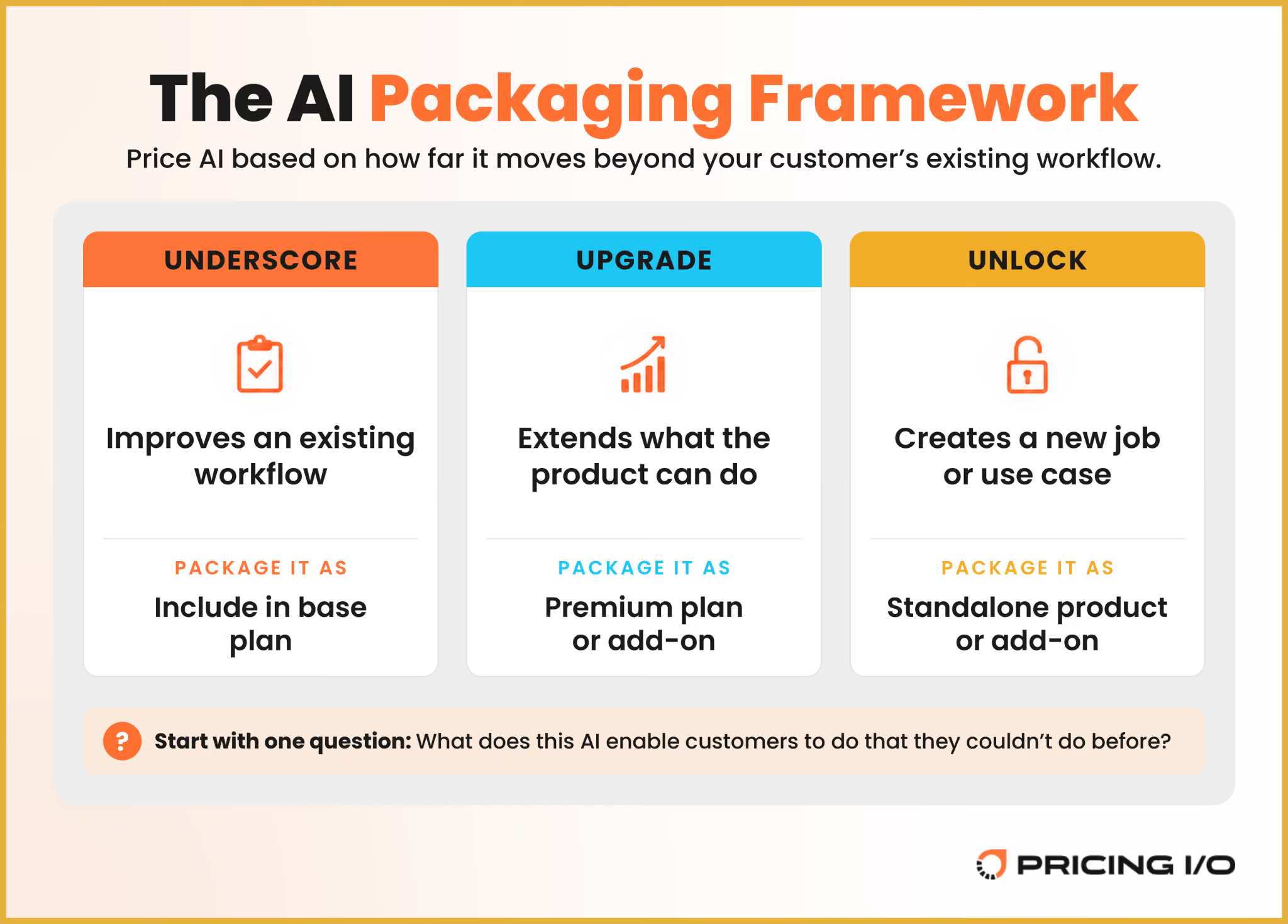
Underscore the core. The AI supports use cases you already serve, only a little faster or a little smarter. Fold it into the base plan, align it with the pricing metric you already have, and consider moving on price once customers are consistently getting value from the capability. Slack followed a similar path. It initially launched Slack AI as a paid add-on, then later incorporated AI capabilities into Business+ while increasing the annual Business+ price from $12.50 to $15 per user.
Upgrade the more. The AI extends the use case with additional steps or more complexity, something the customer couldn't do before. Put it in the premium plan or make it an add-on, so the customers who don't want that complexity aren't paying for it.
Unlock the new. A use case nobody has attacked before, or a user you've never sold to. This one can stand alone, bundle with the product, or sell as an add-on, and it's the one you can carve out and price separately.
The middle route is the hardest of the three. If the use case is common, tuck it in. If it's genuinely new, you can probably pull it out and sell it. What decides it is how far the experience sits from what the customer does today.
The worst version of this is shipping AI into the product and charging for it before anyone uses it. Customers who haven't adopted the feature will read that invoice line and wonder what they're paying for. Packaging your reps can't explain slows deals down, and a charge your customers can't justify comes back at renewal.
Mistake 3: charging for the wrong thing
This is the biggest of the three, and it's the one underneath most of the public reversals.
The unit you want is work: something measurable, recognizable and familiar, with a state at the end of it. Conversations completed, transactions approved, packages sent, photos edited. You can count it, and it finishes.
That end state is the tricky part, because you're measuring at the point where the customer sees a benefit or some level of completeness. Most companies end up charging for a proxy such as time, usage or output. Those can work, but only if buyers see a clear connection between the unit being measured and the outcome they're paying for.
Get the unit wrong and you don't just lose revenue. You change how the customer behaves. If Netflix charged you for every show you watched, your viewing would look different. The same thing happens inside a business. People work around the meter, avoid the action that costs them, and use the product less. If there's a way around it, somebody will find it. Usage flattens, accounts stop expanding, and it reads like an adoption problem long before anyone traces it back to the pricing.
Buyers weight this more heavily than most vendors assume. In Pricing I/O and Benchmarkit's 2026 survey of 296 software buyers, 63% put a clear value metric among their top three pricing priorities, ahead of clear ROI at 49% and ease of justifying the spend to finance at 47%. The only thing they wanted more was a predictable total cost.
Everything else follows from the unit. Whether you build a credit system buyers can forecast or a hybrid of fixed and variable pricing, the model only works if the thing being metered was right to begin with, and what buyers are asking for throughout is a number they can follow.
What this comes down to
AI hasn't changed what customers value. They still want a clear outcome, pricing they can follow, and a bill they can predict. What AI changed is how much value you can deliver, and with it how much room you have to capture.
The companies doing well here have made the value obvious. They can point at what the AI produced, they've put it where their customers understand it, and they charge for something a buyer would recognise as work. A customer who can follow that logic will accept a higher price. That is what makes an increase hold instead of turning into a reversal.
Frequently asked questions
What if your competitors are giving their AI away for free?
Give people a taste before you gate it. One company we watched opened up free access at launch, then introduced tiers once usage proved the value was real, keeping the basic capability free and charging for the depth. Validate that customers want it before you charge a lot for it, and don't let a competitor's free tier push you into a decision you haven't tested.
How does giving AI away affect your margins?
The LLM cost wasn't in your P&L before and it is now, so every month you include AI without charging for it comes off the margin. CFOs are already worried about margin compression, and 42% of companies are either not charging for AI or still deciding how. Treat a free period as an experiment with an end date rather than a position.
How do you know when customers value an AI feature enough to charge for it?
Look for adoption in the usage data and movement in your satisfaction scores before you touch the price. That evidence is what lets you defend an increase to existing customers, and it's the difference between a price rise that holds and one that turns into a churn conversation.