TL;DR
- Charging for a single unit breaks in the AI era because usage is uneven across customers and can be spiky within one, while 68% of buyers still rank a predictable total cost among their top three priorities.
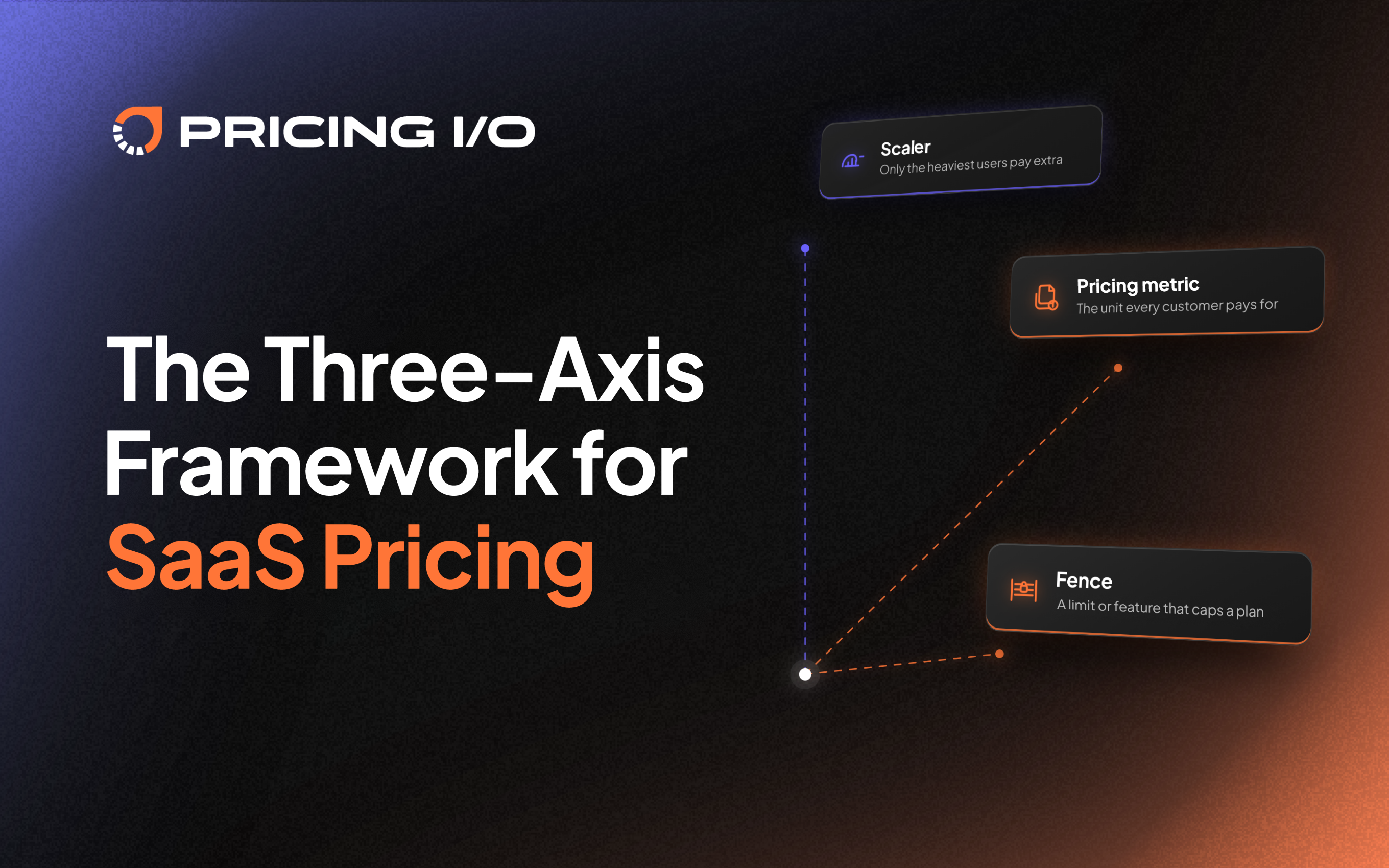
- Pricing metric: charge for one countable unit of work that a buyer can see on the invoice and understand.
- Scaler: a second metric, included up to a threshold set at the natural cutoff between typical and heavy usage, often around the 70th percentile, so most customers never hit it.
- Fence: a limit or feature that marks the edge of a plan, such as a cap of 5 users or single sign-on only in the top tier, so customers land in the plan that fits their size and needs.
- Together they make a hybrid, which buyers prefer to outcome pricing: in Pricing I/O and Benchmarkit's 2026 survey of 296 software buyers, 73.6% viewed hybrid seat-plus-usage positively, against 37.1% for pure outcome-based.
- Keep per-user pricing when value still grows with headcount, as in collaboration tools and CRMs.
Why one value metric isn't enough in the AI era
Per-user pricing works when one person does about one person's worth of work. AI breaks that link: one employee running an AI agent can consume what a whole team used to, so two customers on the same per-user price get very different value. Charging for usage instead fixes that and creates a new problem, because most customers can no longer predict their bill. Whatever single unit you charge for, some customers sit far outside the range the price was built for.
Buyers will pay more when they use more, but only if they can see the bill coming. In the 2026 survey, 68% ranked a predictable total cost among their top three priorities. Per-user pricing still has the highest net preference of any model, at +17 (buyers who favor it minus buyers who don't), because a user count is easy to forecast. The three-axis framework keeps that predictability while charging for uneven usage, by splitting pricing across three levers: the unit customers pay for, a second variable only the heaviest users pay for, and the limits and features that decide which plan a customer belongs on.
Axis 1: the pricing metric, the unit you charge for
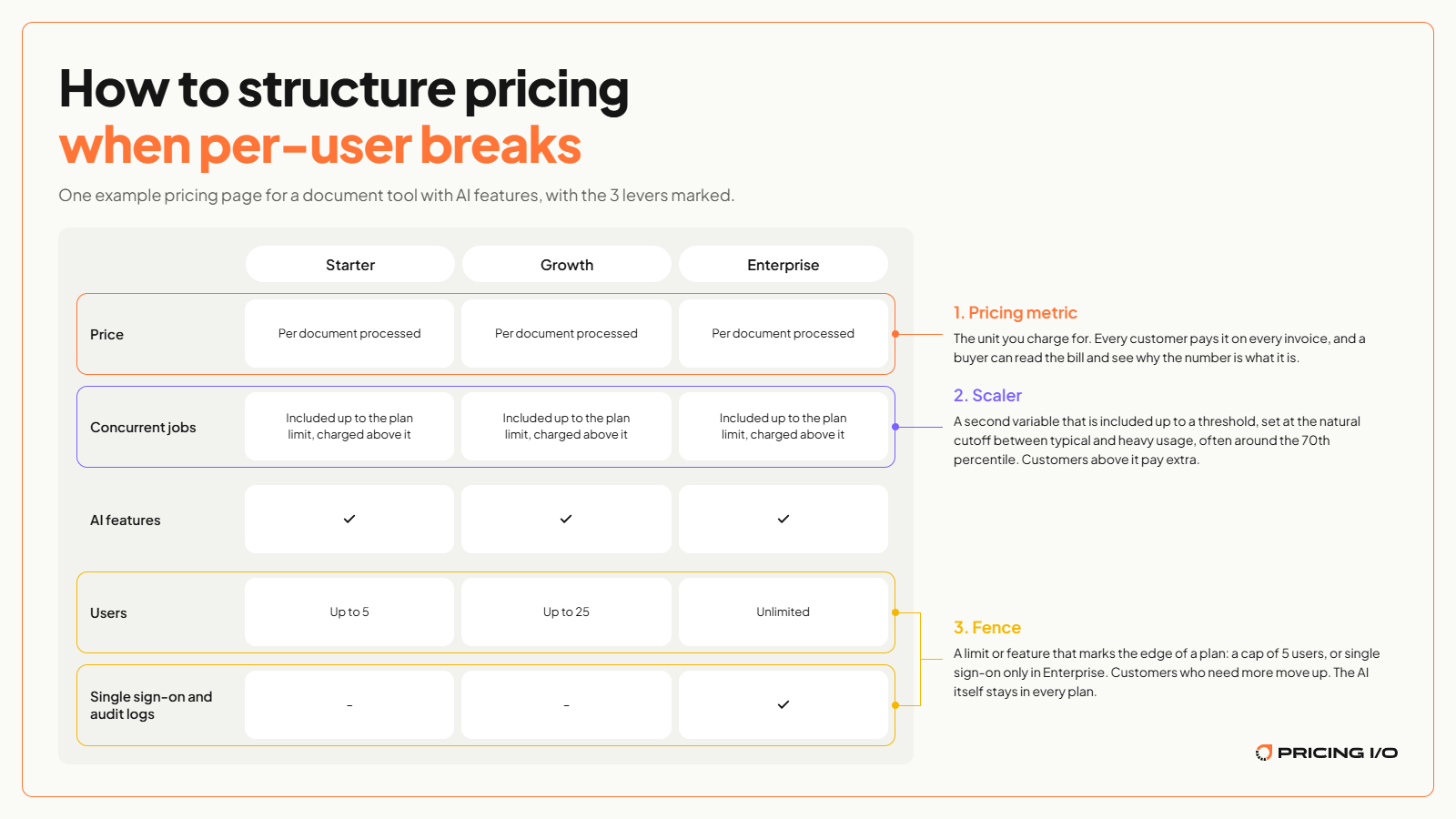
The pricing metric is what the customer pays for explicitly, the unit on the order form and every invoice. For a product with AI in it, that should be work the customer can count: documents processed, data rows enriched, automations run. The test is whether a buyer can read the invoice and see why the number is what it is.
Charge for one primary unit. The framework as a whole charges for more than one thing, but only one of them should be the headline on the invoice. A price built on two headline units, say documents and API calls, asks the buyer to forecast both before they can budget for either, and 63% of buyers put a clear value metric among their top three priorities. Choosing the unit is covered in how to monetize AI without hurting growth. The unit AI products most often pick, and the one that most often fails the invoice test, is the credit. A credit costs $0.005 at Salesforce and $0.25 at Lovable, with different work behind each, so a buyer reading "500 credits" can't tell what they got, which is why buyers rate credit-based pricing the hardest model to evaluate.
Axis 2: the scaler, the quiet multiplier
A scaler is a variable that differs across customers enough to matter but is too noisy, or too loosely tied to value, to be the pricing metric. You set a threshold, include everything below it in the base price, and charge only for what runs above it. Typical scalers are API rate limits (how many requests a customer's systems can send per minute), workspace size, number of environments, model choice, and concurrent jobs.
Set the threshold at natural cutoffs in volume, typically about the 70th percentile of customers so that the majority fall inside the base range and aren’t paying for the scaler. The top end of customers whose scale is beyond their peers and are utilizing the system in a meaningfully deeper way, pay for that additional usage or throughput, without it needing to be a conversation for every customer. It also is a metric to grow into, so is less likely to be a point of friction at new logo sale, and is more relevant with an already sticky customer.
A customer can cross the threshold without noticing, so publish the band, meter it in the product, and warn before they reach it. A soft cap, which pauses at the limit and asks the customer to approve continuing, was the spend control buyers wanted most, at 62%, against 40% for a hard cap that cuts the product off. Where to place that alert is covered in how to control AI spend. Revisit the band quarterly, because usage shifts with every AI feature shipped.
Axis 3: the fence, the packaging limiter
The first two axes move with usage, so they track a customer's growth but not what kind of customer they are. A ten-person startup and a regulated enterprise can process the same number of documents; only one needs a record of who did what. The fence handles that difference.
A fence marks the edge of a plan, and it comes in two forms. A metric fence is a limit on a number: the Starter plan allows up to 5 users or 3 projects, and a customer who needs a sixth user can't buy one more (if they could, it’d be a scaler), they move up to the next plan. A feature fence is a capability that only exists in a higher plan: single sign-on, audit logs, fine-tuning (training the model on the customer's own data), permission controls, or a support agreement with guaranteed response times. Either way the fence draws a line, and customers who need what's past it move up a tier, which is how it sorts customers into the plan that matches their size and needs. A buyer can usually tell which plan they belong on from the fences alone.
The difference from a scaler is what happens at the line. A scaler lets the customer keep going and charges for the extra. A fence stops them until they change plan.
Keep the AI itself out of the fences. The pricing metric already charges for its work, so putting the AI feature in the top plan as well makes the customer pay to reach it and pay again to use it. Fence what sits around the AI, such as admin controls and activity logs, not the AI.
Why this beats outcome-based pricing right now
Charging for the results the AI produces works only when three conditions hold: the result can be traced to the AI rather than the people around it, it can be checked against what the customer achieved before, and both sides agreed the measure before purchase. Miss one and you get disputes over who caused the result, and revenue can shrink as the product improves, because a more capable AI finishes the job in fewer billable steps. Buyers rate it accordingly: only 37.1% viewed pure outcome-based pricing positively, against 73.6% for hybrid seat-plus-usage, and it had the lowest net preference of any model, at –19. Only 10% would choose it for an AI product they consider essential.
The three axes give you a hybrid, a fixed part plus a variable part, without solving attribution first. Charge for a stand-in you can measure today and add outcome pricing later as results become easier to trace. The cost is operational: three levers need reliable usage measurement, accurate billing, and a sales team that can explain each in a sentence. Without those, a simpler model with less upside is the better choice.
When to keep per-user pricing
Per-user pricing still works when a product's value grows with the number of people using it, the pattern in collaboration tools, CRMs and project management platforms. The three axes are for products where automation has broken that link. If it's intact, scalers and fences only complicate a model that was working.
Frequently asked questions
What is a scaler in SaaS pricing?
A usage variable that isn't the main charge but separates heavy customers from typical ones, such as API rate limits or concurrent jobs. It's included in the pricing up to a threshold and charged above it, with the threshold set at the natural cutoff between typical and heavy usage, often around the 70th percentile.
What is a fence in SaaS pricing?
A limit or feature that marks the edge of a plan: a cap such as 5 users per tier, or a capability such as single sign-on that only exists higher up. It doesn't measure usage; it sorts customers into the plan that matches their size and needs.
What is the difference between a pricing metric and a scaler?
Both are value metrics. A pricing metric is charged to every customer and appears on every invoice. A scaler is charged only to customers above a threshold, but it still appears on order forms and packaging descriptions. One captures value from everyone, the other only from the heaviest users. A scaler can also be a bridge for introducing a new pricing metric: customers get used to seeing the metric and the tracking is in place before it becomes the main charge.
Is per-user pricing dead in the AI era?
No. It still works when value grows with the number of users, as in collaboration tools and CRMs, and it still has the highest net buyer preference of any model, at +17. It breaks when AI does the work headcount used to.
Should AI products use outcome-based pricing?
Only when the result can be traced to the AI, checked against a baseline, and the measure was agreed before purchase. Few AI products meet all three yet, and buyers rate pure outcome-based pricing lowest of any model, at –19.
All buyer figures in this post are from Pricing I/O and Benchmarkit's 2026 AI Pricing Report, a survey of 296 software buyers on how they evaluate and budget for AI pricing.
Get the design checked before it ships
Each of the three choices in this post, which unit to charge for, where the scaler band sits and where the fences go, can go wrong in ways you only see once customers are on the new model. If you want a second opinion on the design before that point, book a call. Pricing I/O has helped 480+ B2B SaaS and AI companies work out the best way to charge for their value.