Industries

SaaS pricing for fintech companies

Fintech pricing is tied to something countable — a transaction, an invoice, a verification. Your costs move with the same meter, and most pricing was set before anyone modelled what happens at ten times the volume.
Talk to an Expert
Explore Case Studies
Trusted by 30+ fintech companies
Industry Challenges

Why fintech pricing breaks at scale

Fintech pricing tracks money movement, so revenue grows when your customers grow. So do your costs. At high volume they can outgrow revenue, and margin falls as you scale.
See How We Help →

COMMON CHALLENGES

Your costs move with the same meter
API calls, data providers, compliance checks, bank connections. The things you pay for scale with the thing you charge for.
Your revenue rides your customer's cycle
Transaction pricing is the strongest retention engine in software when volumes grow. When your customers slow down, it works in reverse.
AI in lending and credit carries a compliance cost
Creditworthiness and insurance risk pricing are high-risk under the EU AI Act from December 2027. Those features carry inference cost and regulatory cost together.
European Commission, EU AI Act implementation timeline.
Your buyer models everything
Treasurers, controllers and CFOs price out total cost for a living. Our research found buyers rank predictable cost over a low entry price by more than three to one.
Source: Pricing I/O, The AI Report, 2026.
480+
B2B SaaS and AI clients
30+
in fintech
15x
Average ROI in year one
$780M
ARR captured for clients
Where We Help

How we help fintech companies

Contact Us  →
01
Discover & diagnose
We dig into your sales, product, customer and market data to find where value is created and where revenue leaks — including which accounts are underpriced relative to the volume they run through you.
02
Design & validate
We build the model with your team and test the impact customer by customer before you commit, designed around how your costs behave as volume grows, with the variable elements bounded so your buyer can still forecast.
03
Deliver & align
We build buy-in across sales, product, finance and leadership while the model takes shape, then hand over the playbook — with pricing your team can defend to a CFO.
Contact Us →
You don't get a lone consultant with a fancy title. You get our entire brain trust — tearing down bad ideas before they reach you.
Meet the Team
TESTIMONIALS

The word on the street
from real SaaS leaders.

1
/
5
"Transparency isn't just a marketing slogan; in pricing, it's the ultimate foundation of trust in the marketplace."
Michael Shields | Tropic
1
/
5

Our fintech pricing playbook
Learn Our Method →
Value metric beyond users
Pricing moves onto what the platform processes — payments, invoices, accounts connected, assets administered — instead of who logs in.
Packaging a buyer can understand
Hundreds of product and module variants make it hard for a buyer to see what they are getting. Modular packages fix that.
Variable pricing your buyer can forecast
How much it can cost, what each unit costs, and a warning before they hit the limit.
Evidence behind every number
Fintech buyers rebuild your pricing in their own model. So every price point comes with the analysis that produced it.
Moving the existing base without losing it
Repricing existing customers is where most pricing changes fail. You get a migration plan by segment before anything changes.
Deciding what AI is worth charging for
Whether an AI feature raises your base price, earns a premium tier, or gets metered. In credit and lending, compliance cost is part of that answer.
Learn Our Method →
01
Discover & diagnose
We dig deep into your sales, product, customer, and market data to find where value is being created and where revenue is leaking out.
Fintech sub-sectors

The pricing problems we see across fintech sub-sectors

01
Accounting and practice management
Sold per user to firms that are automating headcount away. The seat count falls while the product does more.
02
Payments and money movement
You charge a percentage of volume. Interchange, processing and fraud take a share of the same transaction, so growth can shrink what you keep.
03
AR, AP and B2B payments
Priced per invoice, so your revenue follows your customer's business cycle rather than anything you control.
04
Wealth and advisor operations
Priced per advisor, while the value scales with the assets under administration and the documents moving through the platform.
05
Financial data and market intelligence
Your costs track query volume and data licensing. Heavy users can cost more than they pay.
06
Billing and subscription management
Charging a percentage of your customer's revenue means your price rises on its own, and gets renegotiated every time they grow.
07
Treasury and liquidity management
Sold per user to finance teams that stay the same size, while the value sits in the cash volume and bank connections you manage.
08
Lending and credit
Priced per loan or per application, and AI in credit decisions carries regulatory obligations that cost money to meet.
Our Process

One proven process,
shaped around your needs.

Every engagement follows a connected pricing process, with the depth and ongoing support shaped around your needs.
01

Research

Find where value is created, and where it isn't

02

Guidance

See what you're charging versus what you could

03

Research

Build pricing that's easy to sell and easy to buy

04

Validation

See the revenue impact before you commit

05

Implementation

Leave with a board-ready model and the org behind it

06

Execute & Optimize

Keep pricing improving as the business changes

Sprint

Answer a focused pricing question
Research → Guidance

Design

Build, validate & launch your pricing
Research → Implementation

Currv

Continuously execute, measure & opimize
Research → Execute & Optimize
Fintech pricing models

Which pricing model fits fintech?

Fintech companies are moving off per-user pricing faster than their buyers are ready for. 
Per user
Per transaction or event
Percentage of volume
Platform fee plus variable
What you charge for
Each person with access
Each payment, invoice, verification or application
A share of the money moving through you
A fixed base plus a metered element
Where we see it work
Treasury, wealth and accounting platforms, where a small team runs the whole thing
Verification, lending and AR platforms, where you can count the work
Payments platforms, where your value rises with the money moved
Most of fintech, once the platform does more than the team does
Where it breaks
Your revenue falls as your customer automates, even as the product does more for them
The fee per event stops covering what the event costs you
Interchange and processing take their share first, so your margin narrows as volume rises
Your buyer can't follow how the variable half works
Per user
What you charge for
Each person with access
Where we see it work
Verification, lending and AR platforms, where you can count the work
Where it breaks
Your revenue falls as your customer automates, even as the product does more for them
Per transaction or event
What you charge for
Each payment, invoice, verification or application
Where we see it work
Verification, lending and AR platforms, where you can count the work
Where it breaks
The fee per event stops covering what the event costs you
Percentage of volume
What you charge for
A share of the money moving through you
Where we see it work
Payments platforms, where your value rises with the money moved
Where it breaks
Interchange and processing take their share first, so your margin narrows as volume rises
Platform fee plus variable
What you charge for
A fixed base plus a metered element
Where we see it work
Most of fintech, once the platform does more than the team does
Where it breaks
Your buyer can't follow how the variable half works
Ways to work together

Engagements scaled to your moment.

Same proven process every time. Scope and duration depend on your complexity, goals, and level of engagement.

Sprint

4-6 weeks
One focused input to a pricing challenge: research, a competitive read, or senior judgment on the decision in front of you. Best for teams who need clarity fast, not a new pricing model.
Uncover what customers actually value and what they'll pay for
Secret shop your pricing, packaging, and positioning against real competitors
Senior, unbiased guidance on a high-stakes decision
Talk to us
Limited early access

Design

12-16 weeks on average
Our flagship engagement, and how most teams work with us. The full build, tailored to your business. Best for when your current model can't scale with your growth plans.
‍
Understand customer behavior, value drivers, market context, and revenue leakage
Build a pricing and packaging model aligned to customer value and business goals
Model revenue impact and align stakeholders behind the change
Walk away with a model your board can back and your team can launch
Talk to us
Limited early access

Sprint

Ongoing
 Currv is our Pricing Decision Platform, and a companion app to our engagements, where your pricing lives and improves. Best for teams who want pricing to keep working long after launch.
Your pricing model, data, and guardrails in one system
Pushes pricing out to the tools that execute it
Continuous analysis of where revenue is leaking
A dedicated strategist pod on the decisions that matter
Request early access
Limited early access
Street Pricing

Real-world pricing expertise, built from hundreds of SaaS engagements.

"Stay curious, take the lead, and help others." It's the philosophy our founder, Marcos Rivera, learned growing up in the Bronx. Add two decades in SaaS pricing and a hand-picked and trained team that shares it, and you get how Pricing I/O works. No theory, no decks, just work that delivers.

Street Pricing Book

Marcos Rivera's playbook for SaaS leaders: the frameworks and hard-won lessons behind how we work.

Street Pricing Podcast

Conversations with founders & operators applying our principles to real-world pricing and growth challenges.
View all resources →
FAQ

Questions from fintech leaders

Read the full FAQ →

Has Pricing I/O worked with fintech companies?

Yes — 30 and counting, across payments, treasury, billing, AR automation, identity verification, wealth operations, accounting software and compliance platforms. Kyriba replaced hundreds of product variants with modular packages and moved from user-based to platform usage pricing.

How should fintech companies price AI features?

It depends on what the AI does. If it speeds up an existing workflow, build it into the base and raise the price once adoption is high. If it takes on work a person used to do, charge for it separately. In credit decisioning and insurance risk, factor in the compliance cost — those use cases are classified high-risk under the EU AI Act. More on pricing AI products.

Should fintech companies price per transaction or as a percentage of volume?

Per transaction works when one event equals one unit of work — a verification, an invoice, an application. Percentage of volume works when your value genuinely scales with the amount of money moving, and when you can hold margin after interchange and processing take their share. Most platforms end up with a base fee plus one variable element rather than either on its own.

What should a fintech platform charge for if seat counts aren't growing?

Charge for what the platform processes. Payments run, invoices handled, accounts connected, assets administered, entities monitored. It has to be measurable, it has to grow when your customer gets more value, and a finance team has to be able to forecast it.

Will fintech buyers accept usage-based pricing?

Finance buyers accept variability. They don't accept surprise. Give them a ceiling they can see, a rate they understand, and a warning before they reach it. Our research with 296 software buyers found predictable total cost ranks far above a low entry price.

Read the full FAQ →
Our Blog

Articles and insights from
the pricing frontlines.

View All Posts →
September 25, 2026

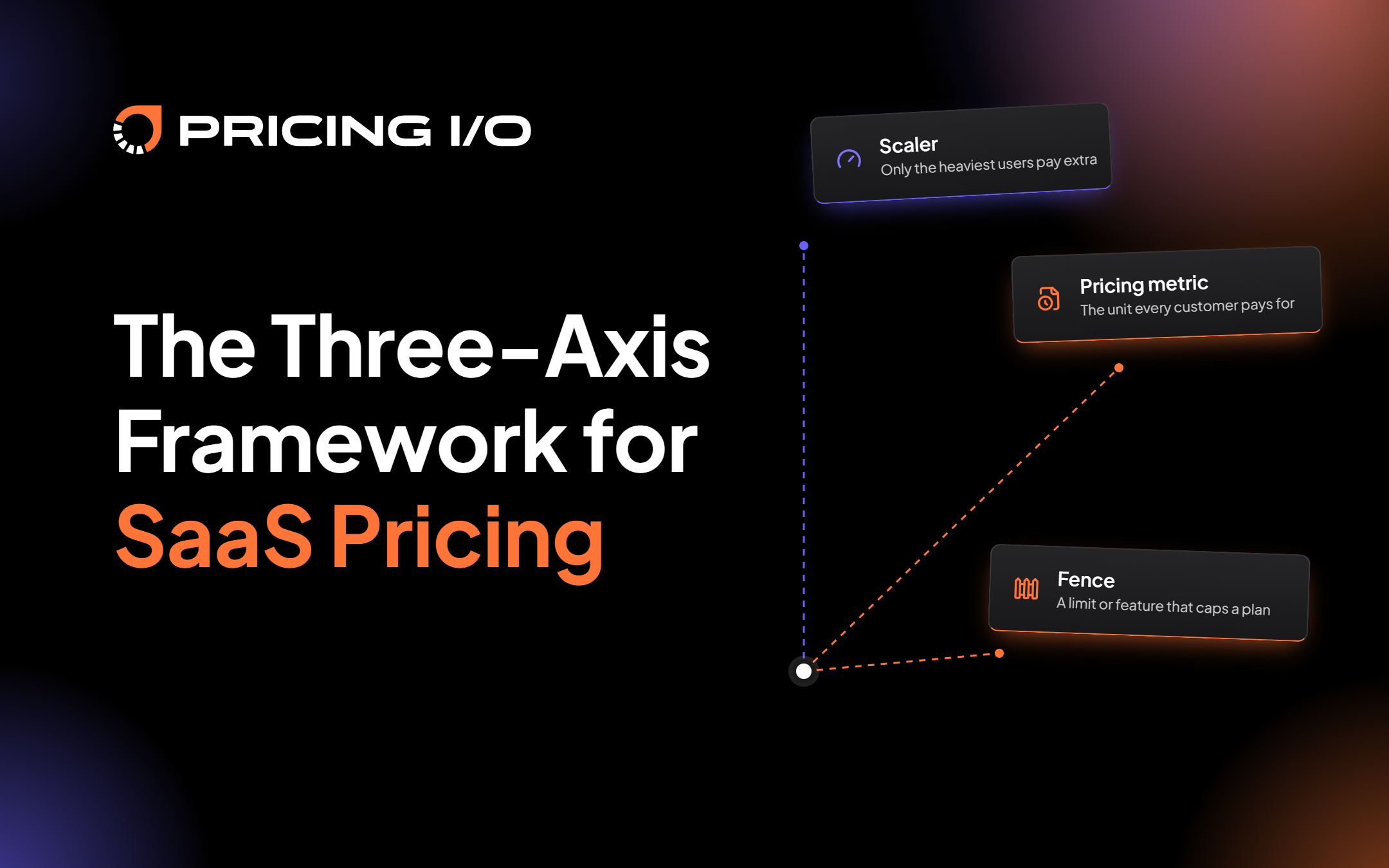
How to Structure SaaS Pricing When Per-User Breaks: The Three-Axis Framework

August 21, 2026

How to Interview Customers About Pricing (Without Asking What They'd Pay)

August 7, 2026

How to Monetize AI Without Hurting Growth