Industries

SaaS pricing for developer tools and infrastructure companies

Developers adopt your product long before anyone pays for it. We rebuild pricing for API platforms, databases, DevOps tooling and developer infrastructure so the free tier brings in customers instead of replacing them.
Talk to an Expert
Explore Case Studies
Trusted by developer tools, API platforms, data platforms and collaboration software
DevOps pricing challenges

Where developer tools and infrastructure pricing breaks

Developers adopt your product before anyone signs anything. So every pricing decision comes down to two things: what you give away up front, and when you start charging.
See How We Help →

COMMON CHALLENGES

You're giving away more than you meant to
Teams run production workloads on free plans and open editions for years. The line between free and paid was drawn when the product did less, and neither the line nor the prices above it have moved since.
Your buyer can't predict what they'll spend
You charge on credits, data volume, throughput or bandwidth. When one credit covers storage, delivery and processing from the same pool, your customer cannot work out what a month will cost until the bill arrives.
Hitting the limit is the worst moment in your pricing
Every plan has a limit, and your most active customers reach it first. Suspend the account and you cut off your best users. Auto-upgrade them and they get a bill nobody agreed to. Charge overage and it lands 30 to 50 percent above their base rate.
Vendr, developer platform pricing analysis, 2026.
An AI agent uses your product for a thousand people. Who pays?
Some platforms have stopped counting people and started counting how many separate sets of data are being queried. Others add a usage meter on top of the seat. Charge by login alone and a thousand people working through one agent bill as one.
480+
B2B SaaS and AI clients
15x
Average ROI in year one
96%
Client satisfaction rate
$780M
ARR captured for clients
Where We Help

How we help developer tools and infrastructure companies

Contact Us  →
01
Discover & diagnose
We dig into your sales, product, customer and market data to find where value is created and where revenue leaks — including which accounts are running production workloads on a free plan.
02
Design & validate
We build the model with your team and test the impact customer by customer before you commit. The free tier earns its place, the paid tiers reflect what the product does now, and the limits are ones your buyer can plan around.
03
Deliver & align
We build buy-in across sales, product, finance and leadership while the model takes shape, then hand over the playbook — with pricing your team can defend to the developer who evaluates it and the CTO who approves it.
Contact Us →
You don't get a lone consultant with a fancy title. You get our entire brain trust — tearing down bad ideas before they reach you.
Meet the Team
TESTIMONIALS

The word on the street
from real SaaS leaders.

1
/
5
"It was a pleasure to collaborate and workshop ideas together. Couldn't have done this without you! By handling everything so professionally and making yourself available, you allowed me to work on other priorities while this work was getting done. I would have probably dropped the ball and not known how to continue forward at certain stages of the process."
Gergana | LucidLink — Director of Growth Marketing
1
/
5

Our pricing playbook for devtools and infrastructure
Learn Our Method →
A free tier that converts
Most free tiers were set when the product did less. We work out what should sit inside one now, and what you have been giving away for years without meaning to.
Pricing an engineering team can forecast
Your customer should be able to estimate next month's bill before they get it. That means one number to watch rather than several, limits they understand, and nothing unexpected when it arrives.
A limit that doesn't damage the relationship
Suspending the account, upgrading them automatically or charging overage all cost you something. We design what happens instead, so hitting the limit stops being the worst moment in your pricing.
A pricing page a developer can evaluate
Developers research before anyone talks to them. If your pricing page does not show what they will pay and why, you lose people you never knew were looking.
A value metric that survives AI agents
A per-seat price stops working when one agent acts for many people. We find what to charge for instead, and make sure it still counts when the work is automated.
Moving your existing customers without losing them
Repricing existing customers is where most pricing changes fail. You get a migration plan by segment before anything changes.
Learn Our Method →
01
Discover & diagnose
We dig deep into your sales, product, customer, and market data to find where value is being created and where revenue is leaking out.
DevOps sub-sectors

The pricing problems we see across developer tools and infrastructure

01
API and developer platforms
Design and testing tools charge per seat; gateways charge per call. The seat-priced ones are now adding usage meters on top, because the humans in the tool are doing less of the work than the machines are.
02
Databases and data stores
Priced on nodes or data volume, with a free edition capable of running production. Nothing in the product pushes them to pay, so the upgrade only happens when compliance or support requires it.
03
Data quality and observability
Priced on how much data you process, so your customers send you less of it. They cut around a third of the data they send and stop monitoring some systems altogether, just to keep the bill down.
04
Media and file infrastructure
Storage, delivery and processing all draw from the same credit balance. Your customer cannot tell which one will run it down, so they cannot forecast the bill.
LabLynx, 2026.
05
Cloud hosting and web operations
Priced on traffic, so your revenue genuinely grows with your customer's success. The catch is that they cannot predict traffic, so they cannot predict the bill.
06
Experimentation and analytics
Priced on events or seats, while the value sits in the decisions your customer makes from the results. Running more experiments costs them more, whether or not the results were useful.
07
Design and collaboration tools
Priced per seat in organizations that keep seat counts down. Licenses get shared or passed around, so you are paid for far fewer people than actually use the product.
Our Process

One proven process,
shaped around your needs.

Every engagement follows a connected pricing process, with the depth and ongoing support shaped around your needs.
01

Research

Find where value is created, and where it isn't

02

Guidance

See what you're charging versus what you could

03

Research

Build pricing that's easy to sell and easy to buy

04

Validation

See the revenue impact before you commit

05

Implementation

Leave with a board-ready model and the org behind it

06

Execute & Optimize

Keep pricing improving as the business changes

Sprint

Answer a focused pricing question
Research → Guidance

Design

Build, validate & launch your pricing
Research → Implementation

Currv

Continuously execute, measure & opimize
Research → Execute & Optimize
DevOps pricing models

 Which pricing model fits developer tools and DevOps?

Developer tools are priced on people, machines, projects or usage. The question is which of them your customer can predict, and which one grows when they get more value from your product.
Per seat
Per node, host or environment
Per project or site
Consumption
What you charge for
Each named user with a login
Each server, cluster or environment running your software
Each site, app, repository or workspace
Credits, data volume, calls or bandwidth used
Where we see it work
Design, testing and collaboration tools a person works in directly
Databases, gateways and anything deployed on the customer's own infrastructure
Hosting and tools where one project is one unit of work
Gateways and platforms where usage genuinely tracks value delivered
Where it breaks
Automation and AI agents do the work, so your revenue stops growing while usage does
Your customer runs the same workload on fewer, larger machines and pays you less
Your customer merges twenty small projects into one and pays for one
Your customer cannot forecast the bill, so they cap usage and you lose the growth
Per seat
What you charge for
Each named user with a login
Where we see it work
Databases, gateways and anything deployed on the customer's own infrastructure
Where it breaks
Automation and AI agents do the work, so your revenue stops growing while usage does
Per node, host or environment
What you charge for
Each server, cluster or environment running your software
Where we see it work
Databases, gateways and anything deployed on the customer's own infrastructure
Where it breaks
Your customer runs the same workload on fewer, larger machines and pays you less
Per project or site
What you charge for
Each site, app, repository or workspace
Where we see it work
Hosting and tools where one project is one unit of work
Where it breaks
Your customer merges twenty small projects into one and pays for one
Consumption
What you charge for
Credits, data volume, calls or bandwidth used
Where we see it work
Gateways and platforms where usage genuinely tracks value delivered
Where it breaks
Your customer cannot forecast the bill, so they cap usage and you lose the growth
Ways to work together

Engagements scaled to your moment.

Same proven process every time. Scope and duration depend on your complexity, goals, and level of engagement.

Sprint

4-6 weeks
One focused input to a pricing challenge: research, a competitive read, or senior judgment on the decision in front of you. Best for teams who need clarity fast, not a new pricing model.
Uncover what customers actually value and what they'll pay for
Secret shop your pricing, packaging, and positioning against real competitors
Senior, unbiased guidance on a high-stakes decision
Talk to us
Limited early access

Design

12-16 weeks on average
Our flagship engagement, and how most teams work with us. The full build, tailored to your business. Best for when your current model can't scale with your growth plans.
‍
Understand customer behavior, value drivers, market context, and revenue leakage
Build a pricing and packaging model aligned to customer value and business goals
Model revenue impact and align stakeholders behind the change
Walk away with a model your board can back and your team can launch
Talk to us
Limited early access

Sprint

Ongoing
 Currv is our Pricing Decision Platform, and a companion app to our engagements, where your pricing lives and improves. Best for teams who want pricing to keep working long after launch.
Your pricing model, data, and guardrails in one system
Pushes pricing out to the tools that execute it
Continuous analysis of where revenue is leaking
A dedicated strategist pod on the decisions that matter
Request early access
Limited early access
Street Pricing

Real-world pricing expertise, built from hundreds of SaaS engagements.

"Stay curious, take the lead, and help others." It's the philosophy our founder, Marcos Rivera, learned growing up in the Bronx. Add two decades in SaaS pricing and a hand-picked and trained team that shares it, and you get how Pricing I/O works. No theory, no decks, just work that delivers.

Street Pricing Book

Marcos Rivera's playbook for SaaS leaders: the frameworks and hard-won lessons behind how we work.

Street Pricing Podcast

Conversations with founders & operators applying our principles to real-world pricing and growth challenges.
View all resources →
FAQ

Questions from developer tools and infrastructure leaders

Read the full FAQ →

Has Pricing I/O worked with developer tools and infrastructure companies?

Yes — API platforms, databases, data quality and observability, media and file infrastructure, cloud hosting, experimentation, and design and collaboration tools.

What belongs in a developer tool's free tier?

Enough to get a developer productive on their own, and not enough to run a team's production workload indefinitely. Most free tiers fail the second test because they were drawn when the product did less. The line is worth revisiting whenever the product changes materially.

How should DevOps tools price AI features and agents?

Start with what the agent replaces. If it speeds up something a developer already did, it belongs in the base. If it does the work instead of them, a per-seat price stops describing anything — an agent acting for a thousand people is still one login. Some platforms now count access rather than people. More on pricing AI products.

Should developer tools charge per seat or per usage?

Per seat works when a person sits in your product and does the work. Usage works when the value genuinely scales with volume. Most developer tools end up with a base that covers the team and a variable element on top, because pure usage leaves the buyer unable to forecast and pure seats stop counting anything once automation arrives.

How should a developer tools company raise prices?

It depends on why. If the product has grown, repackage — a new tier lands far better than a rise on an unchanged product. If costs have risen or the price was simply too low, say that directly rather than inventing a feature to justify it. In both cases, move the existing base in segments and tell them before the invoice does.

Read the full FAQ →
Our Blog

Articles and insights from
the pricing frontlines.

View All Posts →
September 25, 2026

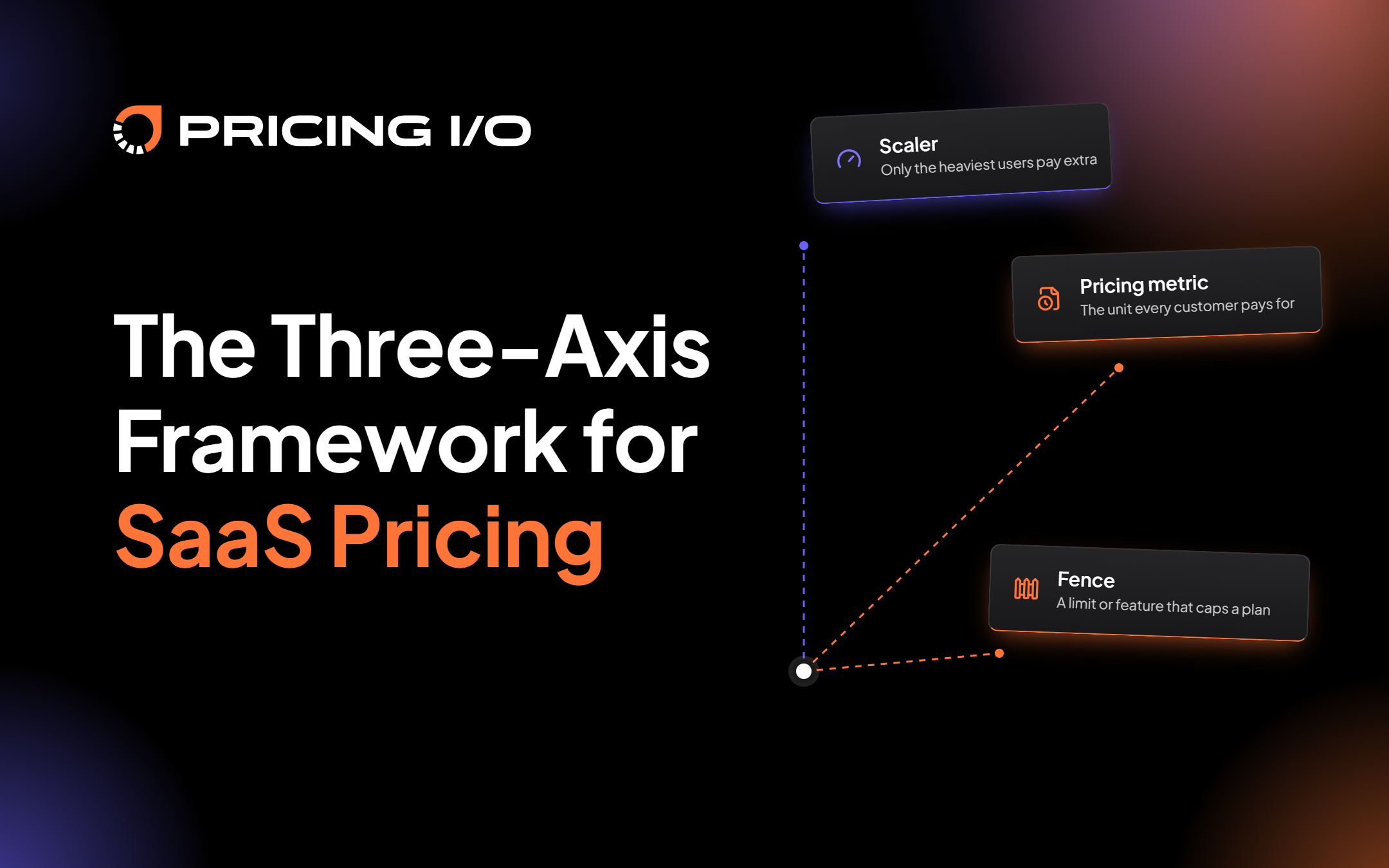
How to Structure SaaS Pricing When Per-User Breaks: The Three-Axis Framework

August 21, 2026

How to Interview Customers About Pricing (Without Asking What They'd Pay)

August 7, 2026

How to Monetize AI Without Hurting Growth