Industries

SaaS pricing for construction software companies

Construction work happens in teams that change every project, and the workload doubles in summer. Most pricing models were not built for either. We rebuild pricing for contractor and trades platforms, project management, preconstruction and construction finance software.
Talk to an Expert
Explore Case Studies
Trusted by contractor, project management, preconstruction and construction finance platforms
Construction software pricing challenges

Where construction software pricing breaks

Per user, per project, unlimited seats, a share of construction volume — this market has tried all of them. Each one breaks somewhere different, usually when your customer's workload swings.
See How We Help →

COMMON CHALLENGES

Half the people on a project aren’t on your customer’s payroll
Subcontractors, suppliers, architects and the owner all need access to the same project. Charge per user and your customer is paying for a team they don't employ — and more buyers are pushing back on it.
JobTread, 2026.
Contractors keep people off the system to avoid the seat
Rather than pay for a seasonal crew member or a subcontractor, they share logins or leave them out. You sell fewer seats, the product shows less value, and the renewal is harder than it should be.
Projul, 2026.
Your revenue drops every winter
Construction workload drops in the cold months, and in some markets it stops. Priced per user or per project, your revenue falls with it, and your smallest customers cancel until spring.
Your AI multiplies output and your price doesn't move
AI now handles up to half of estimating tasks and cuts takeoff time by 70 to 90 percent. Your customer takes the whole gain, because you are still charging for the seat.
Construction estimating market research, 2026.
480+
B2B SaaS and AI clients
16+
in construction software
15x
Average ROI in year one
$780M
ARR captured for clients
Where We Help

How we help construction technology companies

Contact Us  →
01
Discover & diagnose
We dig into your sales, product, customer and market data to find where value is created and where revenue leaks — including which accounts pay far more or less than the value they get.
02
Design & validate
We build the model with your team and test the impact customer by customer. Your price tracks the work the software does, and it holds through a slow winter and a busy summer.
03
Deliver & align
We build buy-in across sales, product, finance and leadership while the model takes shape, then hand over the playbook — with pricing your team can explain to whoever signs, whether that's an owner or a procurement team.
Contact Us →
You don't get a lone consultant with a fancy title. You get our entire brain trust — tearing down bad ideas before they reach you.
Meet the Team
TESTIMONIALS

The word on the street
from real SaaS leaders.

1
/
5
"Pricing I/O helped us move quickly, bring structure to an important pricing transition, and get to a strong outcome fast. Their team brought real expertise, practical guidance, and the right level of pushback for our stage. I'd absolutely recommend them to other CEOs navigating pricing change."
Stacey Epstein | Structured AI — CEO
"We have already started to implement some of the things from our call and have felt the momentum shift by doubling our average number of new customer sign-ups in one week."
Erick Vargas | Followup CRM — COO
"I had been losing money in our business, month on month with low profit and no profit sales, that took 5 years to become profitable. …I had ideas but was not confident in which way to jump, and this caused us to actually stall on the changes we need to make to grow the business, to deliver more value to our customers and to build a thriving business. Thank you wholeheartedly."
Paul Tyrrell | FieldInsight — CEO
1
/
5

Our construction software pricing playbook
Learn Our Method →
A model built for project teams, not headcounts
Your customer's subcontractors, suppliers and architects all need access to the same information. We find a way to charge that doesn't make every extra person a cost.
Pricing that doesn’t push customers to share logins
When adding a person costs money, contractors share logins and leave crew off the system. We find a model where using the software fully is more valuable option for your customer.
Pricing that works in both seasons
Construction workload swings hard between peak and low season. We build a model that carries you through the slow months without spiking your customer's bill in the busy ones.
A price that reflects what your AI does
Your software now does in minutes what an estimator spent days on. We work out how much of that saving belongs in your price instead of all of it going to the customer.
Pricing your buyer can see before they call you
Many construction buyers treat quote-only pricing as a warning sign. Published pricing is a trust signal in this market, and we work out how much of yours can be public.
Moving your existing customers without losing them
Repricing existing customers is where most pricing changes fail. You get a migration plan by segment before anything changes.
Learn Our Method →
01
Discover & diagnose
We dig deep into your sales, product, customer, and market data to find where value is being created and where revenue is leaking out.
Construction software sub-sectors

The pricing problems we see across construction software sub-sectors

01
Contractor and trades software
Your customers staff up in spring and cut back in autumn. Priced per user, you either charge them for seats nobody is using or watch them remove people every winter.
02
Field service management software
Priced per technician, so a 15-person HVAC company pays $44,000 to $90,000 a year before implementation. Every departure removes a seat, and the trades have heavy turnover.
The Contractor Matrix, 2026.
03
Construction project management platforms
Per user, per project, unlimited seats or a share of construction volume — your competitors have tried all four, so your buyer is comparing four different shapes of number.
04
Preconstruction and bidding tools
Priced per estimator at $1,500 to $8,000 a year each. The firm bidding $80 million pays the same as the one bidding $10 million with the same headcount.
BidFlow, 2026.
05
Design and engineering software
Firms here have watched licensing models change for twenty years and treat every new one with suspicion. They reclaim seats when someone leaves and assign them per project, so your licence count shrinks between jobs.
AEC Magazine, 2025.
06
Construction finance and payment platforms
Priced on loan volume or draws processed, so your revenue tracks the lending market rather than your product. Construction loan volume fell 38% in 2023.
Commercial Property Executive, 2023.
Our Process

One proven process,
shaped around your needs.

Every engagement follows a connected pricing process, with the depth and ongoing support shaped around your needs.
01

Research

Find where value is created, and where it isn't

02

Guidance

See what you're charging versus what you could

03

Research

Build pricing that's easy to sell and easy to buy

04

Validation

See the revenue impact before you commit

05

Implementation

Leave with a board-ready model and the org behind it

06

Execute & Optimize

Keep pricing improving as the business changes

Sprint

Answer a focused pricing question
Research → Guidance

Design

Build, validate & launch your pricing
Research → Implementation

Currv

Continuously execute, measure & opimize
Research → Execute & Optimize
Construction software pricing models

Which pricing model fits construction software?

Per user is still the most common model in construction software, but unlimited seats, per project and construction volume pricing have all taken ground. Each one works for someone and fails for someone else.
Per user
Per active project
Unlimited seats by tier
Annual construction volume
What you charge for
Each person with a login
The number of jobs running at once
One price per tier, however many people use it
A share of the total value of work your customer manages
Where we see it work
Office-based tools used by a stable team
Products where one project is one unit of work
Products the whole project team needs, including subcontractors
Large contractors whose project values vary too much for headcount to measure
Where it breaks
Your customer shares logins and leaves crew off the system, so you sell fewer seats than they use
Your customer's project count halves in winter and your revenue follows
You grow only when your customer moves up a tier
Your revenue rises and falls with construction spending, which you do not control
Per user
What you charge for
Each person with a login
Where we see it work
Products where one project is one unit of work
Where it breaks
Your customer shares logins and leaves crew off the system, so you sell fewer seats than they use
Per active project
What you charge for
The number of jobs running at once
Where we see it work
Products where one project is one unit of work
Where it breaks
Your customer's project count halves in winter and your revenue follows
Unlimited seats by tier
What you charge for
One price per tier, however many people use it
Where we see it work
Products the whole project team needs, including subcontractors
Where it breaks
You grow only when your customer moves up a tier
Annual construction volume
What you charge for
A share of the total value of work your customer manages
Where we see it work
Large contractors whose project values vary too much for headcount to measure
Where it breaks
Your revenue rises and falls with construction spending, which you do not control
Ways to work together

Engagements scaled to your moment.

Same proven process every time. Scope and duration depend on your complexity, goals, and level of engagement.

Sprint

4-6 weeks
One focused input to a pricing challenge: research, a competitive read, or senior judgment on the decision in front of you. Best for teams who need clarity fast, not a new pricing model.
Uncover what customers actually value and what they'll pay for
Secret shop your pricing, packaging, and positioning against real competitors
Senior, unbiased guidance on a high-stakes decision
Talk to us
Limited early access

Design

12-16 weeks on average
Our flagship engagement, and how most teams work with us. The full build, tailored to your business. Best for when your current model can't scale with your growth plans.
‍
Understand customer behavior, value drivers, market context, and revenue leakage
Build a pricing and packaging model aligned to customer value and business goals
Model revenue impact and align stakeholders behind the change
Walk away with a model your board can back and your team can launch
Talk to us
Limited early access

Sprint

Ongoing
 Currv is our Pricing Decision Platform, and a companion app to our engagements, where your pricing lives and improves. Best for teams who want pricing to keep working long after launch.
Your pricing model, data, and guardrails in one system
Pushes pricing out to the tools that execute it
Continuous analysis of where revenue is leaking
A dedicated strategist pod on the decisions that matter
Request early access
Limited early access
Street Pricing

Real-world pricing expertise, built from hundreds of SaaS engagements.

"Stay curious, take the lead, and help others." It's the philosophy our founder, Marcos Rivera, learned growing up in the Bronx. Add two decades in SaaS pricing and a hand-picked and trained team that shares it, and you get how Pricing I/O works. No theory, no decks, just work that delivers.

Street Pricing Book

Marcos Rivera's playbook for SaaS leaders: the frameworks and hard-won lessons behind how we work.

Street Pricing Podcast

Conversations with founders & operators applying our principles to real-world pricing and growth challenges.
View all resources →
FAQ

Questions from construction technology leaders

Read the full FAQ →

Has Pricing I/O worked with construction software companies?

Yes — 16 and counting, across contractor and trades platforms, field service, project management, preconstruction and bidding, design and engineering, and construction finance. Our client Roofr rebuilt its pricing around how customers actually buy, from kickoff to rollout in eight months.

Should contractor software charge per user?

Only when your customer's team is stable and small. A construction project brings in subcontractors, suppliers, architects and the owner, and a contractor's headcount doubles in summer. Per user makes all of that expensive, so customers share logins and leave people off the system. Most companies in this market end up with a base that covers the team and a variable element tied to something else.

What should construction software charge for instead of seats?

Whatever the product does that a contractor would count anyway. Jobs run, bids submitted, square footage measured, draws processed, inspections completed. It has to be measurable, and your customer has to be able to check it without calling you.

How should construction technology companies price AI features?

By what the AI replaces, not by adding a line to the seat price. Estimating tools that used to take days now take minutes, and that gain is worth something a per-seat price captures none of. Work out what the saved time is worth to your customer first. More on pricing AI products.

How should construction software price for a seasonal business?

Design for the low season, not the peak. Annual commitments with usage that flexes, or a base plus variable, both let your customer scale down in winter without leaving. Pricing built around the busy months looks great in July and causes churn in January.

Read the full FAQ →
Our Blog

Articles and insights from
the pricing frontlines.

View All Posts →
September 25, 2026

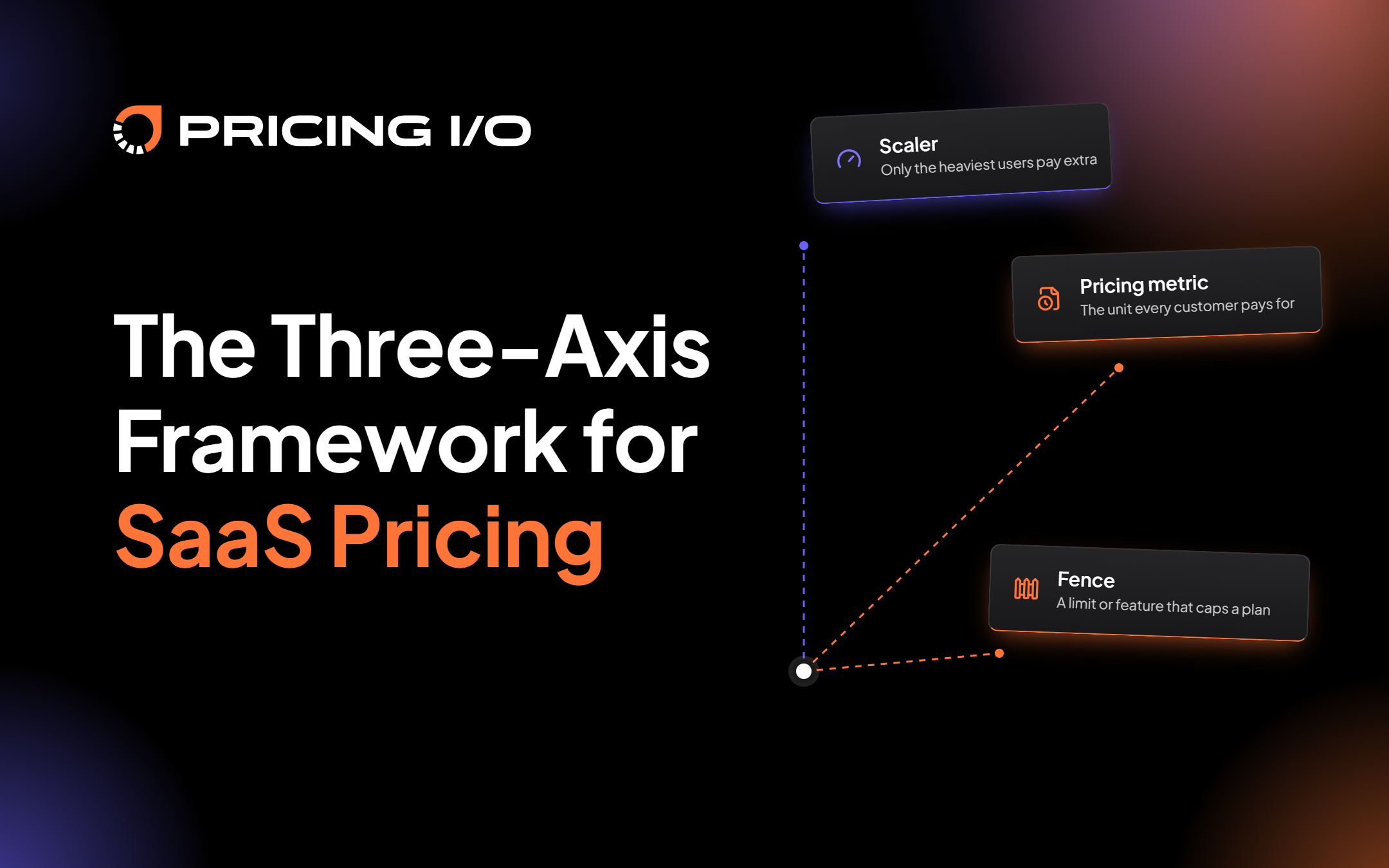
How to Structure SaaS Pricing When Per-User Breaks: The Three-Axis Framework

August 21, 2026

How to Interview Customers About Pricing (Without Asking What They'd Pay)

August 7, 2026

How to Monetize AI Without Hurting Growth